|
|
 |
Dr. Sherif El-Tawil, PE
Associate Professor
Dept. of Civil and Env.
Engineering
University of Michigan
Ann Arbor, MI 48109-2125
Ph (734) 764-5617 Fax (734)
764-4292
eltawil@umich.edu |
Biography
|
|
I graduated with honors from Cairo University
in 1989 with a BS in Civil Engineering. I subsequently joined the Civil
Engineering Department at the University as a teaching assistant in the
Reinforced Concrete Division. After receiving a MS in Structural
Engineering in 1991, also from Cairo University, I attended Cornell University to pursue a PhD in
Civil/Structural Engineering. There I conducted research with Greg
Deierlein, Richard White and Peter Gergely on a variety of topics. In
late 1995, I visited the Nippon Steel Corporation as a research
scientist in their Steel Structure Development Center, where I developed
new computational models for reinforced concrete-steel (RCS) composite
connections. After receiving my PhD degree from Cornell in May 1996, I joined the faculty of the Civil and
Environmental Engineering Department at the University of Central
Florida. At UCF, I pursued computational simulation research on steel and composite
steel-concrete structures, focusing in particular on seismic hazard
mitigation. I also explored a number of other research areas, including
the use of fiber reinforced polymers for strengthening steel and concrete
structures as well applications of shape memory alloys for prestressing
concrete. In fall 2002, I joined the faculty at the University of
Michigan, where I have since been. |
|
Current Research Interests |
|
I am currently interested in how buildings and bridges behave under the extreme
loading conditions generated by manmade and natural hazards such as seismic excitation, collision by heavy objects, and blast. I am
actively investigating how to utilize new materials and technologies to
create innovative structural systems that mitigate the potentially
catastrophic effects of extreme loading. Much of my research is focused
on the computational and theoretical aspects of structural engineering,
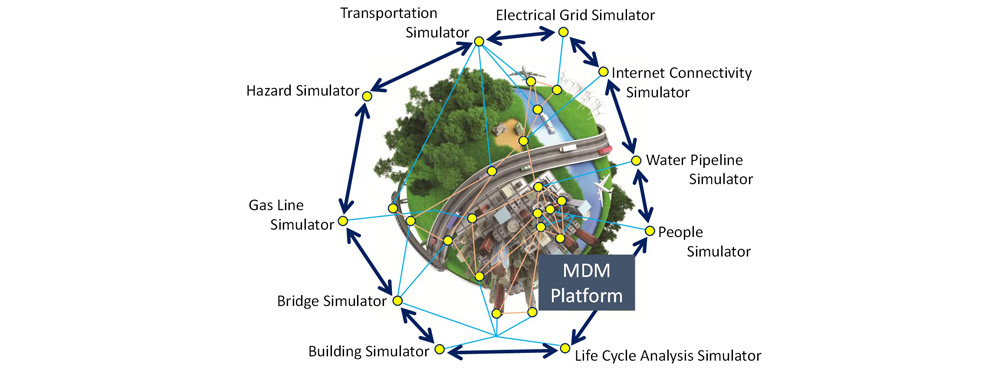
with particular emphasis on computational simulation, grid computing
technology, finite element analysis, constitutive modeling,
macro-plasticity formulations, nonlinear solution strategies and
visualization techniques. My research is sponsored by
NSF, FDOT,
FEMA,
SAC,
CSMIP,
UCF, CATSS,
UM, and the
Nippon
Steel Corporation. |
|
Research Awards |
 | Walter L. Huber Civil
Engineering Research Prize, American Society of Civil Engineers, 2007. |
 | Arthur M. Wellington Prize,
American Society of Civil Engineers, 2006. |
 | Faculty Recognition Award,
University of Michigan, 2006. |
 | Best Paper Award, 2005 Construction Research Congress, San Diego, CA, American
Society of Civil Engineers. |
 | Outstanding Achievement Award,
Department of Civil and Environmental Engineering, University of
Michigan, April 2005. |
 | Norman Medal, American Society
of Civil Engineers, 2002. |
|
|
Research Highlights
|

|
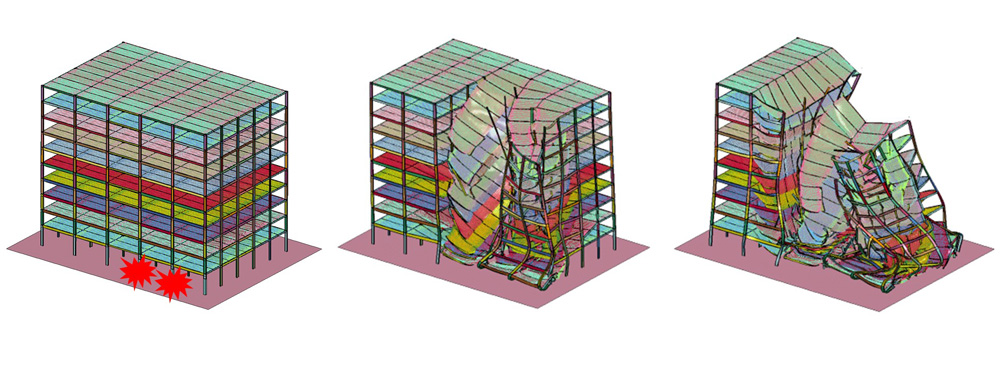
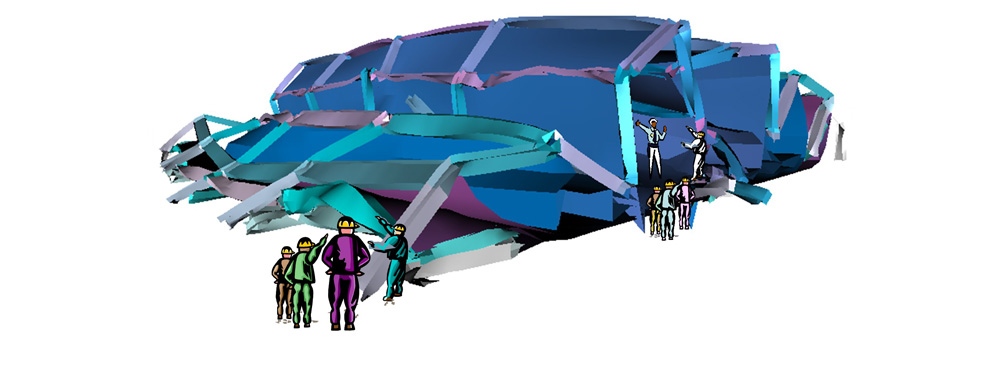
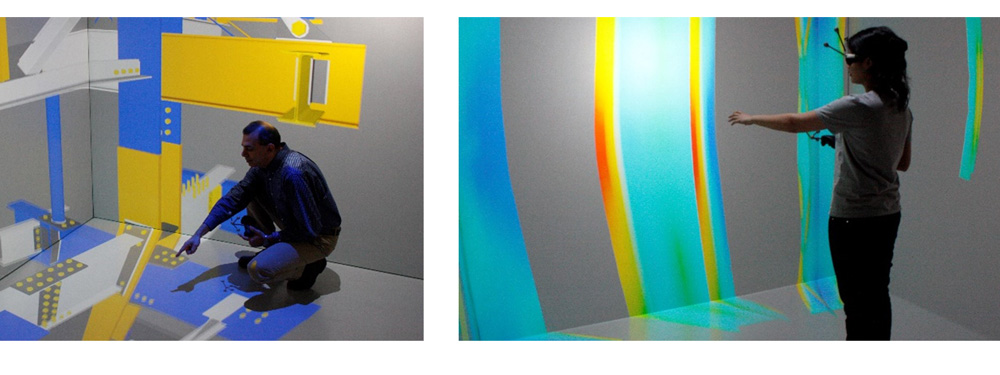
Enter an
imploding steel building (6 MB) or examine
from the outside how the collapse process progresses (19 MB). Visit
CSSL for more information about visualizing finite
element results in virtual reality.
|
|

|
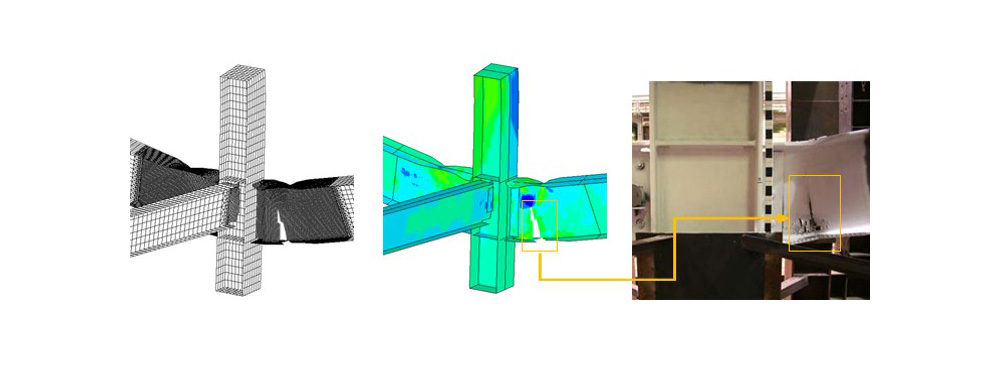
When a critical
column is damaged as a result of an extreme loading event (picture),
catenary action allows gravity load that was previously supported by the
damaged element to span adjacent structural members. The 2 animations below
the results of a simulation conducted to investigate the role of catenary
action as a steel subassemblage responds to column loss. The simulations
shows ductile fracture occurring in a RBS beam-column moment connection as
it undergoes very large deformations in catenary mode.
Top View
(Large file: 13 MB), 3-D View (Large file; 16 MB)
|
|
 |
Some
interesting animations showing higher mode effects (i.e. whiplash effects)
in tall structures subjected to earthquakes. The buildings are
reduced-beam-section steel moment frames and are designed according to the
latest design specifications. The blue colors indicate initiation of
yielding in the members, while the blue triangles indicate plastification of
the reduced beam section.
4-story frame (198
KB),
8-story frame (266 KB),
16-story frame (437 KB)
|
|
 |
Picture
showing overview of crash simulation conducted to investigate bridge
vulnerability to extreme events. The pier, piles, pile cap, surrounding soil,
elastomeric bearings, and superstructure are all modeled in this simulation.
Animation showing
18,000-lb truck colliding with bridge Pier (609 KB).
Closeup of
animation (Large file, 2 MB).
|
|
|