GEOGRAPHY:
SPATIAL ANALYSIS, 
ADVANCED TOPICS
NRE501, SECTION 043 (3 credits)
SCHOOL OF NATURAL RESOURCES AND ENVIRONMENT
THE UNIVERSITY OF MICHIGAN
http://www.umich.edu


Class Resource Pages
http://www.snre.umich.edu/~sarhaus  and follow links


Professor Sandra Arlinghaus (Ph.D.)
Winter, 1999
Wednesdays, 6-9 p.m.
Office in Dana:  2044
Research office:  1130 Hill Street (Community Systems Foundation, CSF)
Phone: 761-1357 (research office); 975-0246 (home, call between 9 a.m. and 9 p.m.--phone with machine)
e-mail: sarhaus@umich.edu (preferred method of communication)
Office Hours:
    Monday (CSF), 10a.m.-1p.m.; Thursday (CSF), 10a.m. - 1p.m.
    Wednesdays available much of the day in Dana.

    Others by appointment.


This course offers students an opportunity to pursue advanced spatial topics related to their own interests. Students must bring their own project to this course (a chapter of a thesis, an ongoing project, or such). In consultation with the instructor, students will be guided to appropriate tools, both theoretical and practical, that enable them to probe various spatial aspects of their project. As technology advances, so too must an understanding of the broad conceptual issues surrounding the technology. 

Class is informal lecture and discussion. 

Course Requirements 
  • Initial description of interests: 5% for a one-page statement handed in on time, the first day. 
  • Midterm oral presentation of about 15 minutes illustrating progress to date; written statement (on diskette) of such to be handed in.Students will be encouraged to capture their work in some sort of electronic format for this presentation (such as PowerPoint---say, 20 slides). This presentation is worth 15% of the grade. 
  • Midterm written project abstract, worth 10% of the grade. 
  • Presentation of the final project (15 minutes for each, as above). Presentation worth 35% of the grade. 
  • Website displaying final project. (Students who do not already know how to do this can get trained in this course, if they wish). Worth 35% of the grade. 
MID-TERM PRESENTATIONS:  Wednesday, March 10.  Party afterwards at Sandy's home. 
FINAL PRESENTATIONS:  Wednesday, April 28.  Party afterwards at Sandy's home. 

 
Overrides are required. Get an override from the instructor.  Students should have some experience with mapping and should have a project in mind.  All students will be required to have an active e-mail account at UM and an active web page.  Students might wish to consider enlarging their ifs home directory space beyond the 10 mb default allocation. 

Class time will be spent in a combination of lecture on appropriate conceptual material and in a seminar/lab format dealing with student project concerns.  It will be instructive for all students to hear the concerns of individuals and to see what sorts of issues are problematic and how they are addressed. 

All software used is for the PC.

In using this website, note that material in table boxes is "official" material; all else is remnant or under construction material.


beiselt Sunday Eiselt Jicarilla Apache in the American Southwest
dkarwan Diana Karwan Changing land use, changing river channels: A study of six watersheds in the Venezuelan Andes.
feec Craig Fee Management of Columbia Spotted Frog and Lahontan Cutthroat Trout in Central and Northeast Nevada; preliminary presentation.
gfiebich Gene Fiebich Impervious Surface Identification Using 3 Different Types of Remotely Sensed Data
huangh Hui-Chun Huang Low-Density Residential Land Use Change in Southeast Michigan
jmeliker Jaymie Meliker Clustering of Asthma Prevalence Around Industrial Complexes
in Southcentral Detroit and Dearborn by GIS Method
mbrush Mark Brush The Effects of Imperviousness on Watersheds: Scio and Superior Townships
ninam Nina Misuraca Macomb County Health Department Surface Water Improvement and Monitoring Program (SWIM)
schlossb Marc Schlossberg Kent County, Community Asset Mapping Project
zgocmen Asli Gocmen Railroad Network in Turkey:  An Application of GIS Buffers and Contours

WEEK 1
 

Course mechanics
  • Class list
  • Overrides
  • E-mail addresses
  • Web pages
Conceptual material:  review of key theorems. Project material:  the modern approaches of the National Geographic Society
  • National Geographic Magazine:  100 years on CD ROM
  • National Geographic Society fold-out maps on CD ROM
Research seminar/lab:  discussion of student interests

WEEK 2
 
 
Web Page Creation--Basic Overview
  • ifs space:  create an html subdirectory within Public directory
  • enlarge ifs space:  at login type umce.itd.umich.edu and follow the links to your individual account and change the ifs amount to which you subscribe (you get 10 free MB--extra MB are charged at some rate per month--think it used to be 9 cents per MB per month).  After you have chosen an amount, hit the Perform Change link.  Then you should be all set.  You might want to wait to see how much more you need before getting more.
  • Create a new page of your own.
  • Insert images as .gif or .jpg format
  • Insert links
  • Put tables in
  • Choose backgrounds
  • ftp material to ifs space:  change name of file to index.html
  • getting material from the Public directory of someone else
Clustering of geographical information
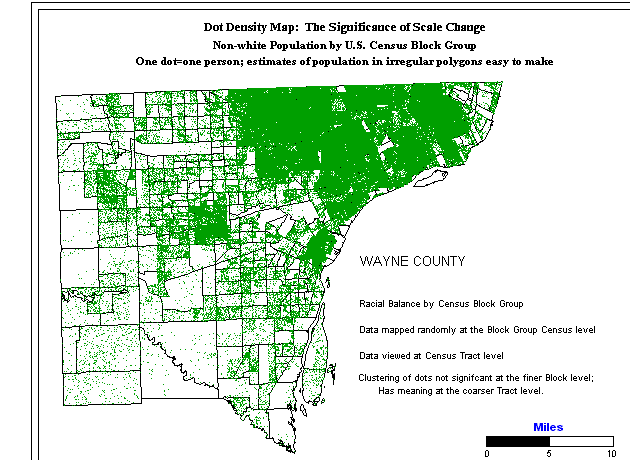
  • Dot Density Maps:  use dot density maps to measure population or other densities in irregularly shaped regions superimposed on these maps.
    • This map shows a single Census variable, non-white population, mapped by Block Group.  One dot represents one percent of the population  in a Block Group.

    • Within a Block Group, dots are scattered randomly.  Thus, position of dots within the block group is meaningless.  However, taking a smaller scale view, using Census Tracts, of the scatter at the Block Group scale, shows where there is clustering within a tract.
    Scale change can reveal pattern!
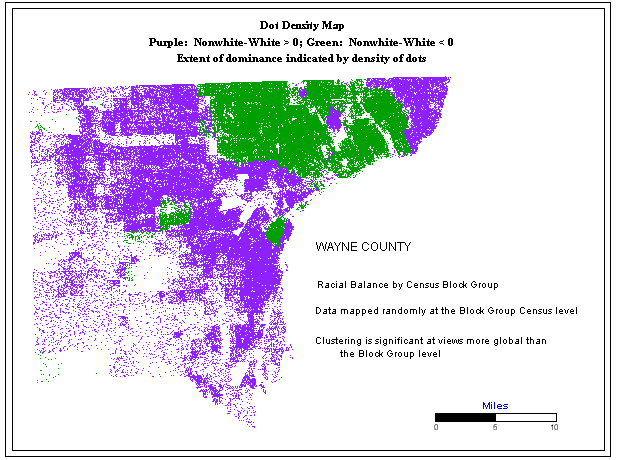
    • Formulas can be written in the GIS.  Thus, comparisons can be made using dots of different colors.  Here values satisfying the inquality
      • Non-white - white > 0
      are green; values satisfying the inequality
        Non-white - white < 0
      are purple.
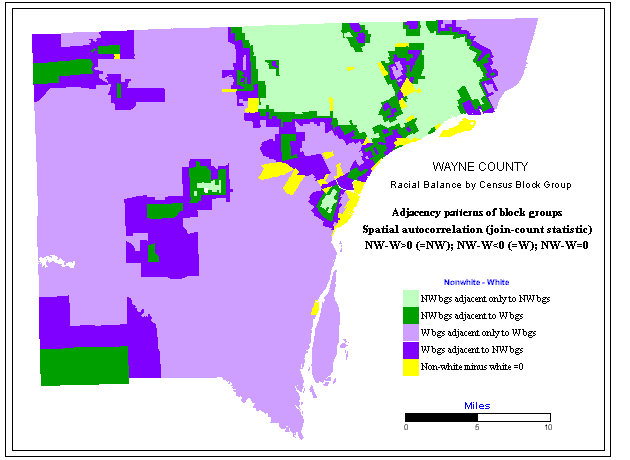
  • Spatial Autocorrelation.  How are regions clustered in space?  Are similar ones next to each other or are dissimilar ones next to each other. 
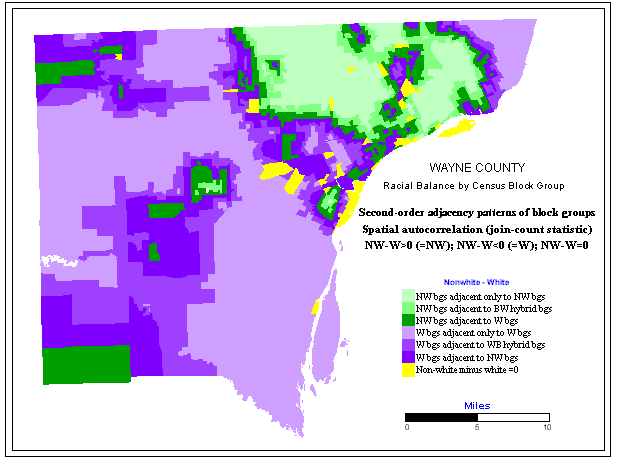
    • On this map, all non-white Block Groups whose adjacent Block Groups are also only non-white are light green.
    • All non-white Block Groups adjacent to white Block Groups are darker green
    • All white Block Groups adjacent to non-white Block Groups are darker purple.
    • All white Block Groups adjacent to only white Block Groups are light purple.
    • This map shows a pattern similar to the first one, but with adjacency counted through two stages.
    • In both maps, when Block Group boundaries are removed, a continuous pattern emerges.
    • Policy makers and municipal authorities may find maps such as these useful
One procedure for making such maps involves using the query tool (in Atlas, for this example). 

     To pick out all block groups in which Nonwhite population dominates (layer test) 
             Query|Select by Layer :  choose the blockgroup layer 
             Query|Select by Value:  choose blockgroups; select subset (or replace selected), by expression, 
                     nonwhite-white>0 
             Edit|Copy to Layer, Selected features only, copy features to new layer--region, called "test" 

     To pick out all block groups in which White population dominates (layer test2) 
             Query|Select by Layer :  choose the blockgroup layer 
             Query|Select by Value:  choose blockgroups; select subset (or replace selected), by expression, 
                     nonwhite-white<0 
             Edit|Copy to Layer, Selected features only, copy features to new layer--region, called "test2" 

     To pick out all block groups that are touching a dissimilar blockgroup:  use test and test 2. 
             Query|Select by Location|Touching:  then, use test followed by test2 to select nonwhite block groups touching white block groups. 
             Query|Select by Location|Touching:  then, use test2 followed by test to select white block groups touching nonwhite block groups. 
             Note the lack of symmetry in adjacency once content is assigned to the blockgroups even though strict adjacency is symmetric (if A is adjacent to B then B is adjacent to A). 

Iteration of technique can produce a contouring of the region; also, weights can be introduced into the formulas. 

Graph-theoretic Background
The text/article shows one way to measure spatial autocorrelation using graph theory and adjacency matrices.

Research Seminar/Lab Material


WEEK 3
 

Randomness, again:  diffusion of an innovation

Measurement of diffusion: a conceptual approach based on the work of Torsten Hagerstrand 

Diffusion is a process in which anything that moves, or that can be moved, is spread through a space, from a source, until it is distributed throughout that space. 

How can diffusion be measured? One way is to trace the positions of things that are being diffused at different times. Torsten Hagerstrand, a Swedish geographer at the University of Lund, used the following technique to trace the diffusion of an innovation. The ‘thing’ being diffused (communicated) is an idea; the agents of diffusion, or carriers of new information, are human beings; the space in which the idea is to be diffused is a region of the world. 

Hagerstrand traces the diffusion process by imitating it with numbers. Such imitation, leading to prediction or forecasting of the pattern of diffusion, is called a simulation of diffusion. To follow the mechanics of this strategy, it is necessary only to understand the concepts of ordering the non-negative integers and of partitioning these numbers into disjoint sets. 

INITIAL SET-UP. 

In Figure 1 contains a map of an hypothetical region of the world. After one year, a number of individuals accept a particular innovation; their spatial distribution is shown in Figure 1. 

MAP BASED ON EMPIRICAL EVIDENCE--REGION INTERIOR IS SHADED WHITE; CELLS WITH NUMERALS IN THEM INDICATE NUMBER OF ACCEPTORS IN LOCAL REGION. 
 

aa a A B C D E F G H I J K L M N
 a
a a a a a a a a a a a a a a a
1
a a a a a a a a a a a a a a a
2
a a a a a a
1
1
a a a a a a a
3
a a a a a a a a a a
1
aa aa aa a
4
a a a a
5
a a a a a a a
1
a a
5
a a a a
2
a a a
a a a a a a
6
a a a a
2
a a a a a a a a a a
7
a a a
1
a a
3
a a a a a a a a
8
a a
1
a
1
1
a a a a a a a a a
9
a a a a
1
a a a a a a a a a a
10
a a a
1
a a a a a a a a a a a
11
a a a a a a a a a a a a a a a
12
a a a a a a a a a a a a a a a

Figure 1. Distribution of original acceptors of an innovation--after 1 year--based on empirical evidence. After Hagerstrand, p. 380. 

In Figure 2, a map of the same region shows the pattern of acceptors after two years--again, based on actual evidence. Notice that the pattern at a later time shows both spatial expansion and infill. These two latter concepts are enduring ones that appear over and over again in spatial analysis---as well as in planning at municipal and other levels. 
 

aa a A B C D E F G H I J K L M N
a
a a a a a a a a a a a a a a a
1
a a a a a


a a a
2


1
1


a a
3
a


1


1
1


a
4
a


6
1


1

1

a
5
a a

2
1


a
6
a


5


7
a

1
1
1
3


a
8
a
1
1
2
2


a
9
a a
1

1


a
10
a a
1


a a a a a a a a
11
a a


a a a a a a a a
12
a a


a a a a a a aa a

Figure 2. Actual distribution of acceptors after two years. 

Might it have been possible to make an educated guess, from Figure 1 alone, as to how the news of the innovation would spread? Could Figure 2 have been generated/predicted from Figure 1? The steps below will use the grid in Figure 3 to assign random numbers to the grid in Figure 1, producing Figure 4 as a simulated distribution, as opposed to the actual distribution of Figure 2, of acceptors after two years. 
 

  • Construct a "floating" grid (Figure 3) to be placed over the grid on the map of Figure 1, with grid cells scaled suitably so that they match. Center the floating grid on a square in Figure 1 in which there exists an adopter (say 2F)...this is the first cell, working left to right and top to bottom, which contains a numeral. The numbers in the floating grid, used with a set of four digit random numbers, will be used to determine likely location of new adopters. It is assumed that the adopter in F2 (or in any other cell) is more likely to communicate with someone nearby than with someone far away; velocity of diffusion is expressed in terms of probability of contact.
  • This assumption regarding distance and probability of contact is reflected in the assignment of numerals within the grid--there are the most four digit numbers in the central cell, and the fewest in the corners. The floating grid partitions the set of four digit numbers {0000, 0001, 0002, ..., 9998, 9999} into 25 mutually disjoint subsets.
Figure 3. 5-cell by 5-cell floating grid overlay, partitioning the set of four digit numbers. 
 
0000
to
0095
0096
to
0235
0236
to
0403
0404
to
0543
0544
to
0639
0640
to
0779
0780
to
1080
1081
to
1627
1628
to
1928
1929
to
2068
2069
to
2236
2237
to
2783
2784
to
7214
7215
to
7761
7762
to
7929
7930
to
8069
8070
to
8370
8371
to
8917
8918
to
9218
9219
to
9358
9359
to
9454
9455
to
9594
9595
to
9762
9763
to
9902
9903
to
9999
  • Given a set (or sets) of four digit random numbers--as below. Center the floating grid on F2. Use the first set of random numbers below. The first number is 6248 and it lies in the center square of the overlay. So in the simulation, the previous Figure 1 acceptor in F2 finds another acceptor nearby in F2. Use the map in Figure 4 to record the simulated distribution (a red entry). In cell F2, enter a red +1 to represent the initial adopter.  Together with the original adopter, there are now two adopters in this cell.
RANDOM NUMBERS a
a a a
SET 1 SET 2 SET 3
a a a
6248 4528 8175
0925 3492 7953
4997 3616 2222
9024 3760 2419
7754 4673 5117
a a a
7617 3397 1318
2854 8165 1648
2077 7015 3423
9262 8874 2156
2841 8443 1975
a a a
9904 7033 3710
9647 0970 4932
3432 2967 1450
3627 0091 4140
3467 6545 5256
a a a
3197 7880 4768
6620 5133 9394
0149 1828 5483
4436 5544 8820
0389 6713 7908
a a a
0703 5920 2416
2105 5745 9414
a a A B C D E F G H I J K L M N
 a
a a a a a a a a a a a a a a a
1
a a a a a
1


a a a
2
a a


1+1
1


a a
3
a


1+1


a
4
a
1
5+1
1+1


1

a
5
a a

2+1
1


1
6
a 1

2+1
1


7
a

1+1


3+1+3


a
8
a
1+1

1+1+1
1


a
9
a a

1


a
10
a 1
1


a a a a a a a a
11
a a


a a a a a a a a
12
a a


a a a a a a a a
Figure 4.  Simulated distribution of acceptors, using Set 1 of Random numbers.  Original acceptors in black; simulated acceptors in red.  Consider what to do with edge effect issues. 
  • Pick up the floating grid and center it on G2. The second random number is 0925, located in the first cell northwest of the center cell of the overlay, cell F1. In Figure 4, a 1 in cell G2 to represent the original adopter, and a 1 in cell F1  represents the later (new) adopter.
  • Continue this process, shifting the overlay so that it is centered on every cell with at least one early adopter (from Figure 1). Work from left to right, top to bottom. Use a different random number for each early adopter. If there are 3 early adopters in a given cell, use three different random numbers in entering the results in Figure 4. Just use the random numbers (supposedly already randomized) reading down the column.
  • How does the simulation (Figures 4) compare to the actual distribution of adopters after two years (Figure 2)?
ANIMATED FILE
Articles on animated maps--scroll down on the attached site: www.imagenet.org

CONCEPTUAL BASE 

Construction of the floating grid--the so-called "Mean Information Field" (MIF)

Assumption: the frequency of social contact (migration) per square kilometer falls off (decays) rapidly with distance. 

Data from an empirical study: 

Units on axes: 

x-axis--distance in kilometers 
y-axis--number of migrating households per square kilometer. 

Definition: 

An area containing probabilities of receiving information from the central point of that region is called a mean information field, represented by Figure 3. 

To assign quantitites of four digit numbers to each cell in the MIF, it is necessary to use the curve derived from the empirical study (distance decay curve). 

It is used to 

  • determine the size of the MIF
  • assign particular probabilities.
Size of MIF

The size of the MIF is 25 by 25 kilometers squared. Observation is that the typical household moves no more than 12.5 kilometers. This field is then split into cells 5 by 5 kilometers squared. 

Assignment of probabilities

From the graph of distance decay, a point 10 km from the center has a value of .167 associated with it. This is in households per square kilometer; there are 25 km squared in each cell; so the point value of the cell is 25*.0167=4.17. The center cell has a value of 110--an actual number of households. 

The total point value of all cells is 248.24--note the symmetry caused by assumptions about ease of movement in all directions outward from the center. 

Divide: 4.17/248.24=0.0168---so, assign 168 4 digit numbers to the cells that are 10 km from the center (two to the north, east, south, and west of center). 

Thus, the Mean Information Field is constructed. 

Some Basic Assumptions of the Simulation Method (Monte Carlo)

Assumptions to create an unbiased gaming table: 

  • the surface is uniform in terms of population and transport
  • all contacts are equally easy in any direction
  • there are an equal number of potential acceptors in each cell
Rules of the game: 
  • There is a set of carriers at the start (as in Figure 1)
  • information is transmitted at constant intervals
  • when carrier meets a new person, acceptance is immediate
  • the likelihood of a carrier and another meeting depends on the distance between them.
References: 

Hagerstrand, Torsten. Innovation Diffusion as a Spatial Process. Translated by Allan Pred. 
University of Chicago Press, 1967. 

Puu, Tonu. Mathematical Location and Land Use Theory.  Springer-Verlag, 1997. 

Possibilities for Application 
     Measure diffusion of neighborhood news over time on city parcel map (see Lawrence and Bar Nur). 
     Simulate animal movement:  large number of random numbers in a strip=stream; tightly bounded intervals = land (for frog, for example). 

Research Seminar/Lab Material


WEEK 4


Conceptual Material
  • Animated maps--show diffusion:  change in spatial properties over time.
  • Mapping of large data sets of points:  geocoding.
Research Seminar/Lab Material


WEEK 5
 

Conceptual Material -- refer to articles on website URL given out in class. 

Fractal base

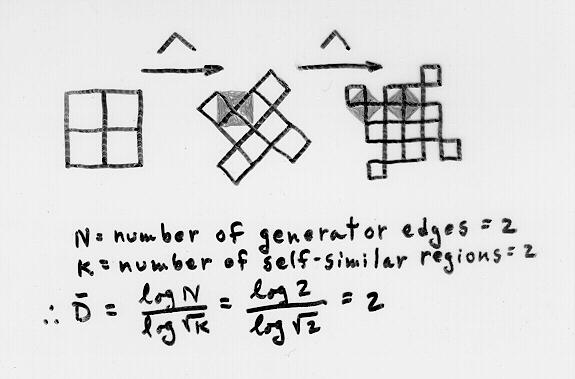
  • Space-filling curves, fractional dimensions, and self-similarity--motivational material.
  • Fractal design for a marina: compact use of space; reprint address supplied in class.
Graph-theoretical base
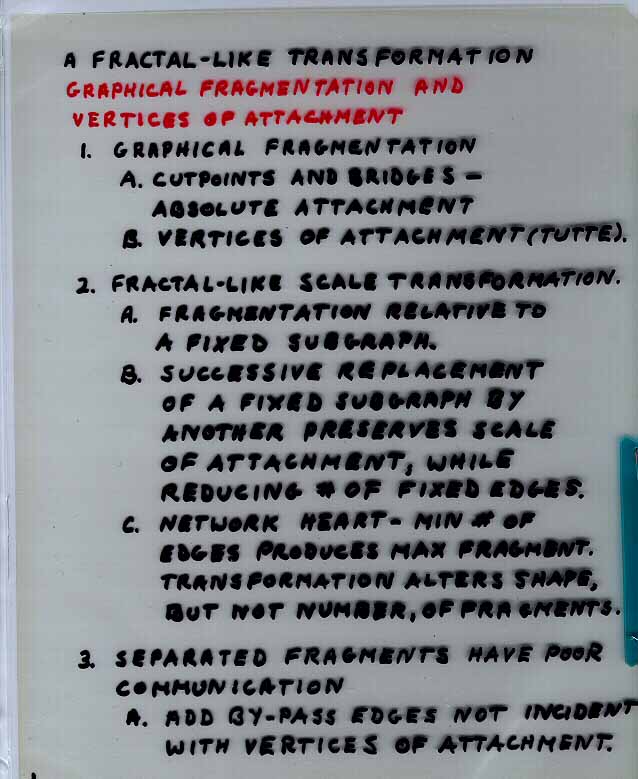
  • Outline  Slide 1
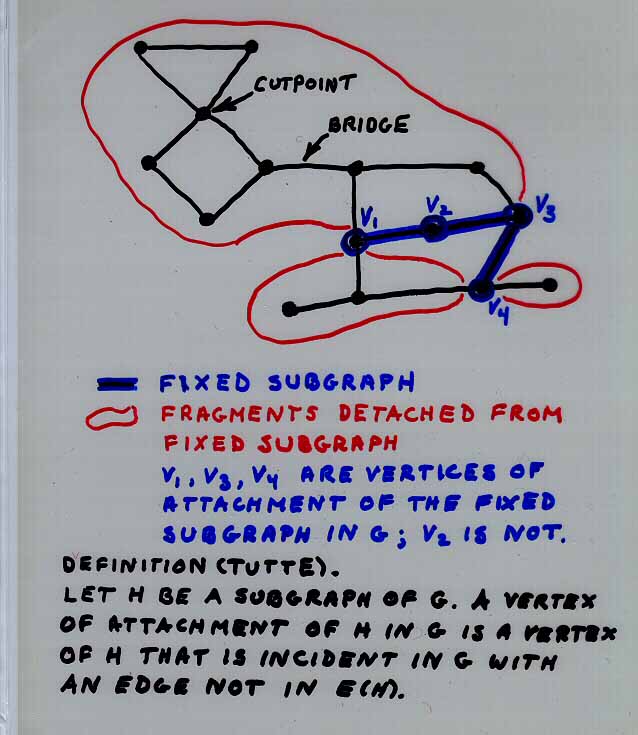
  • Definition of a vertex of attachment (Tutte), involving relative attachment, as opposed to the concept of cutpoint, involving absolute location. Slide 2.
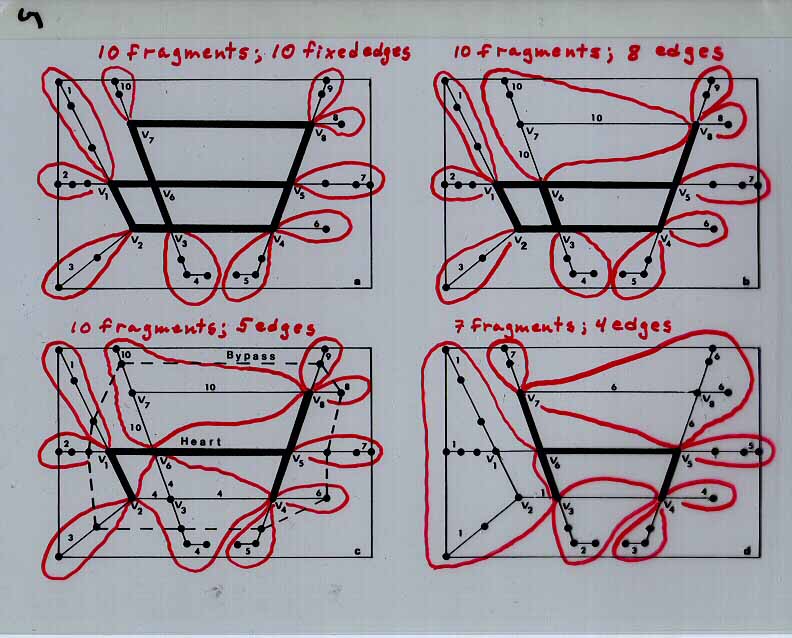
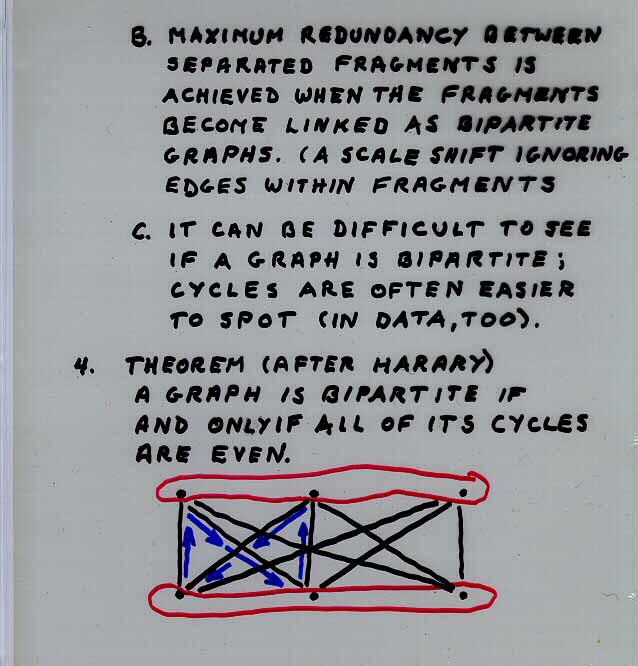
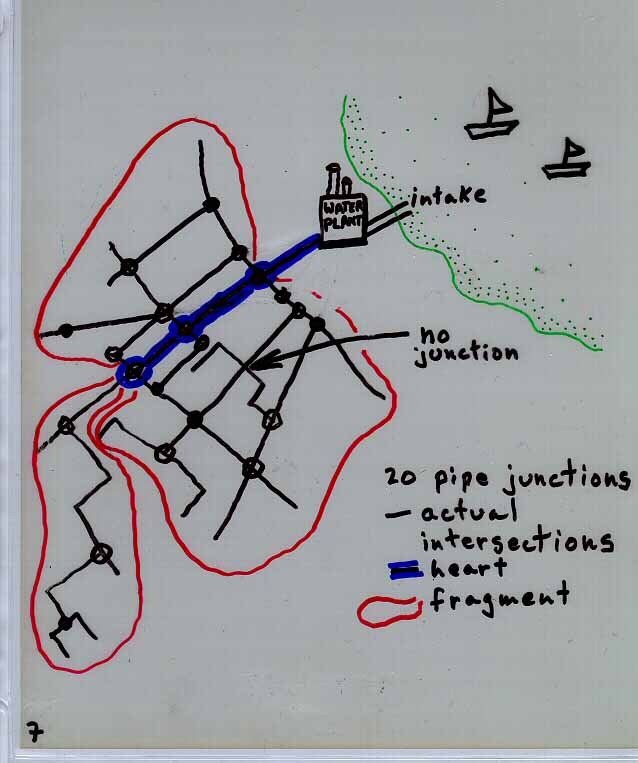
  • Vertices of attachment, fixed subgraphs, network heart, and maximal fragmentation. Network fragments created downstream from a central delivery system.  Slide 3.
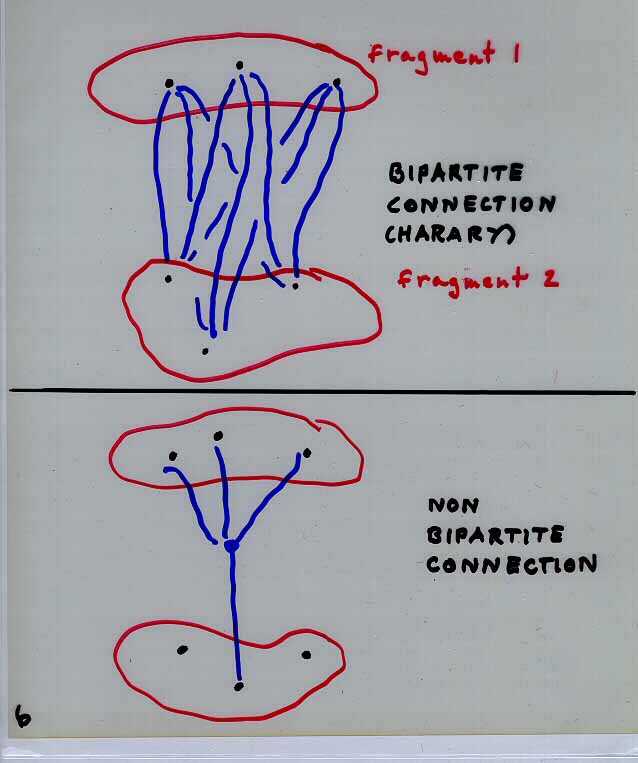
  • Slide 4 Adding redundancy:  maximizing capability of extra links.  Bipartite graphs.  Slide 5.
  • Slide 6
  • Illustration of abstract material applied to a hypothetical real-world water plant.  Slide 7.
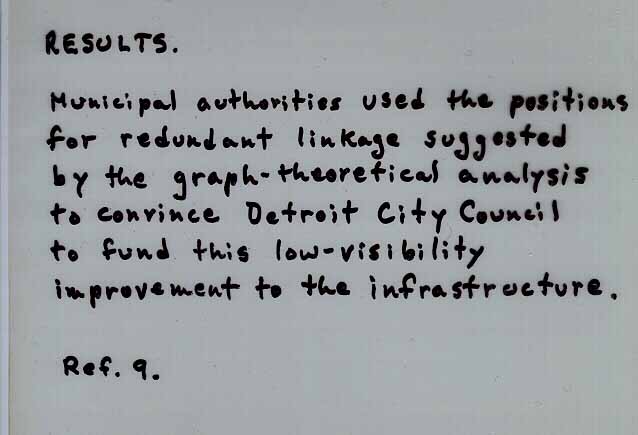
  • Results.  The case of Detroit.  See also reprint of article by Arlinghaus and Nystuen (from Perspectives in Biology and Medicine). Slide 8.
Research Seminar/Lab Material

WEEK 6
 
 
Conceptual Material:  Centrality and Hierarchy -- from the classical to the modern Related references by authors (listed below) appear in traditional published formats:
    Christaller, Walter (books); Losch, August (book); Dacey, Michael (articles); Skinner, G. William (set of three articles); Marshall, John U. (article, Geographical Analysis); Arlinghaus, S. (article, Geografiska Annaler); Arlinghaus S. and Arlinghaus W. (article, Geographical Analysis); S. Arlinghaus, Electronic Geometry, (article, Geographical Review---reprints available).

Related links--click to go to article linked to the website of the 
Mathematica website:  www.wolfram.com
Institute of Mathematical Geography:
    Beyond the Fractal
    Fractal Geometry of Infinite Pixel Sequences: "Super-definition" Resolution?"
    Micro-cell Hex-nets

Related map--partially digitized Christaller map.
    Draft map

Research Seminar/Lab Material
Access to online archive
Consideration of needs for midterm presentation

    PowerPoint
    Data Show and Overhead
    Laptop
Troubleshooting on an individual, one-on-one basis.


WEEK 7
 

Conceptual Material:  Hierarchy, Self-similarity, and Fractals
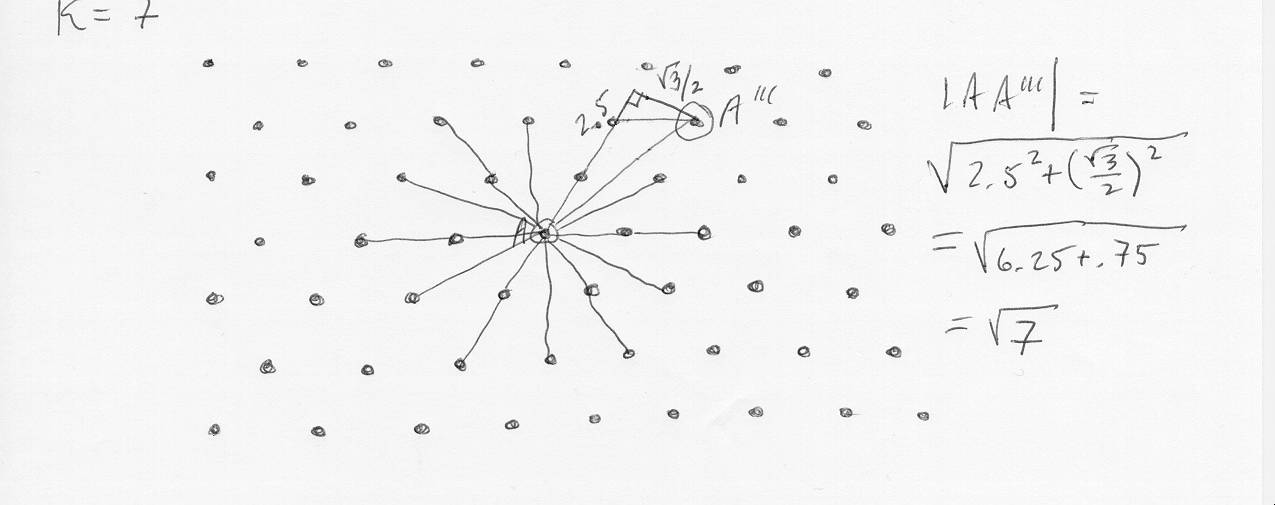
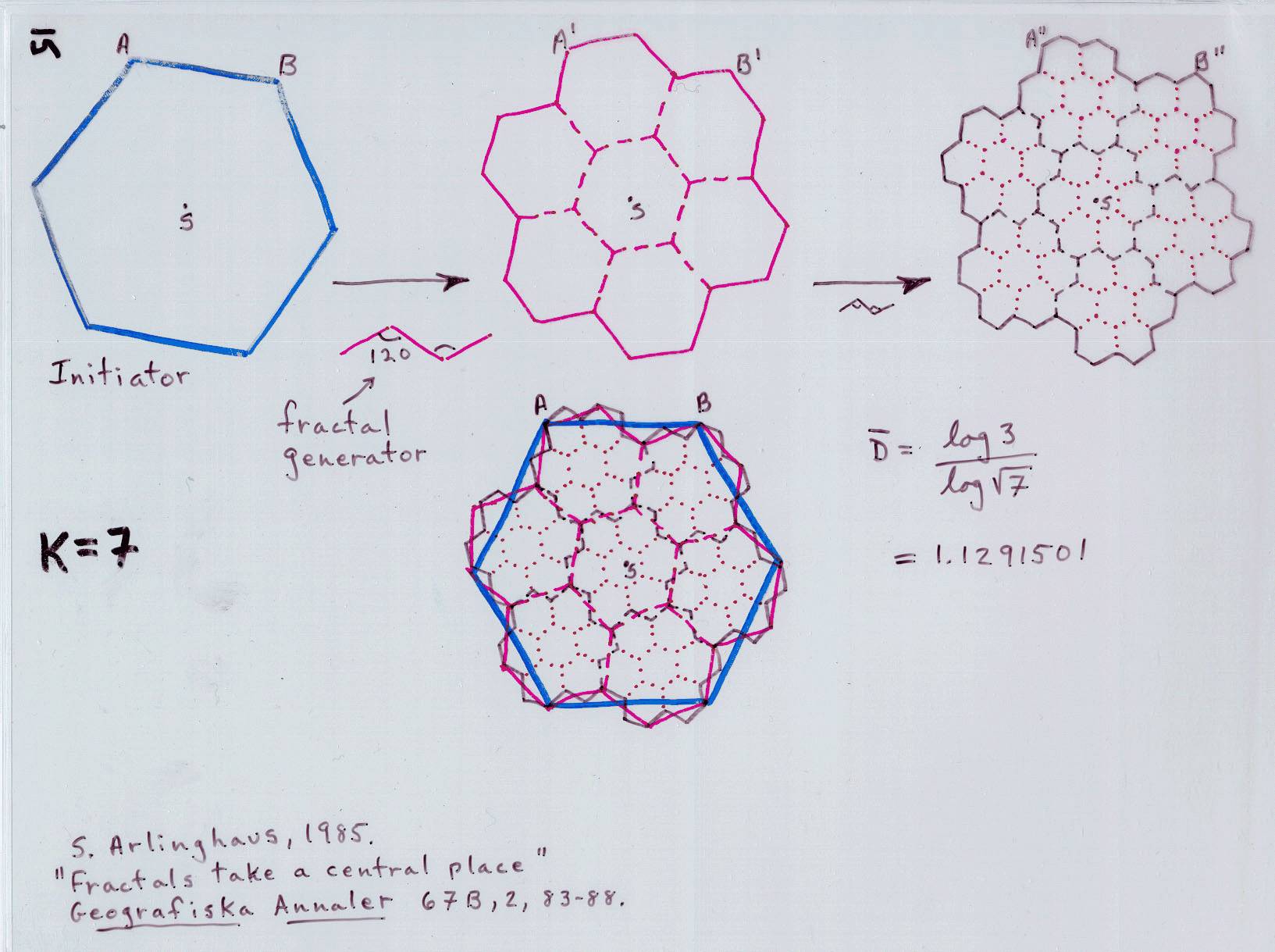
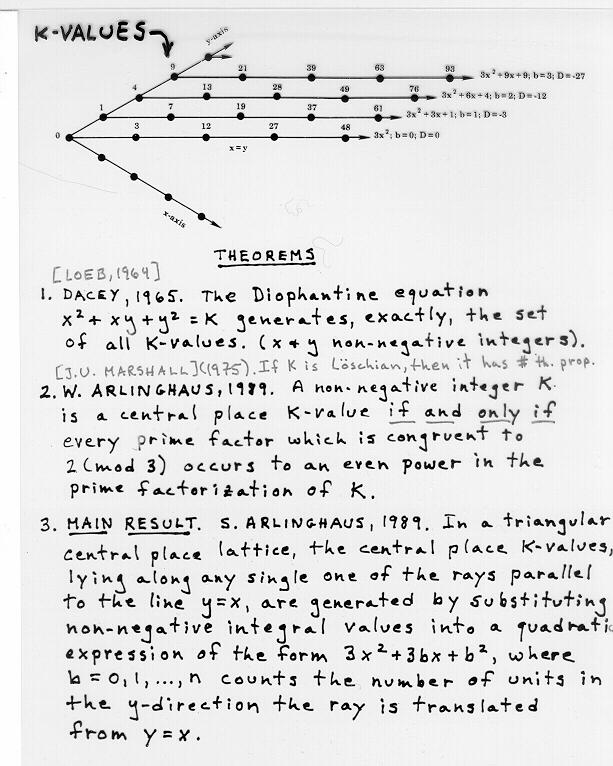
  • Use of the Diophantine equation K=x^2+xy+y^2 to generate classes of higher K values.
  • Partition of higher values into mutually exclusive, exhaustive classes of K-values.
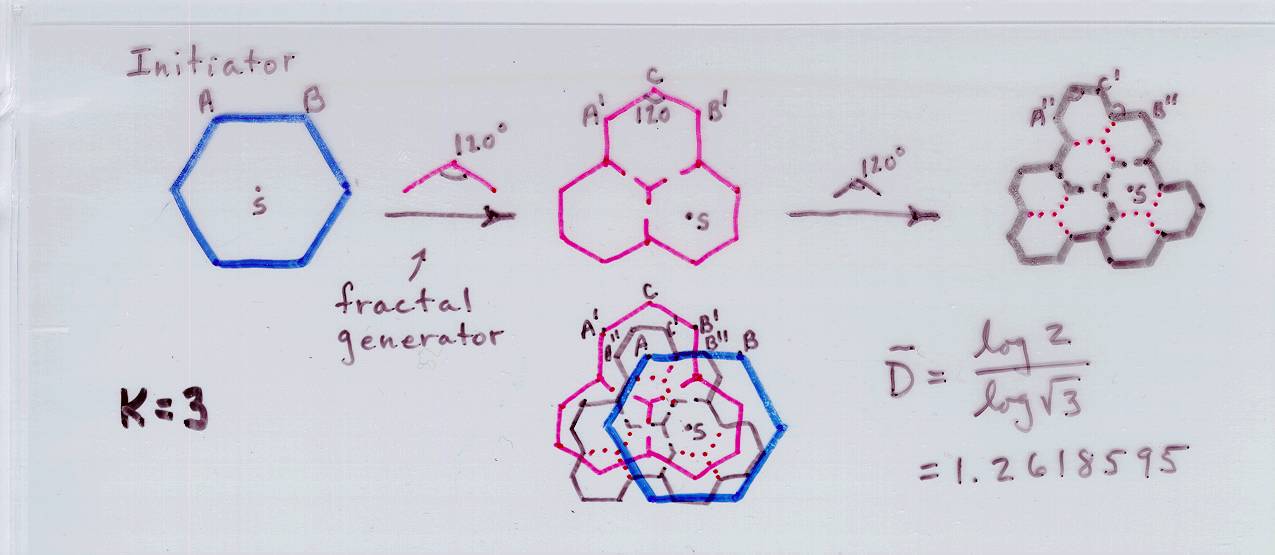
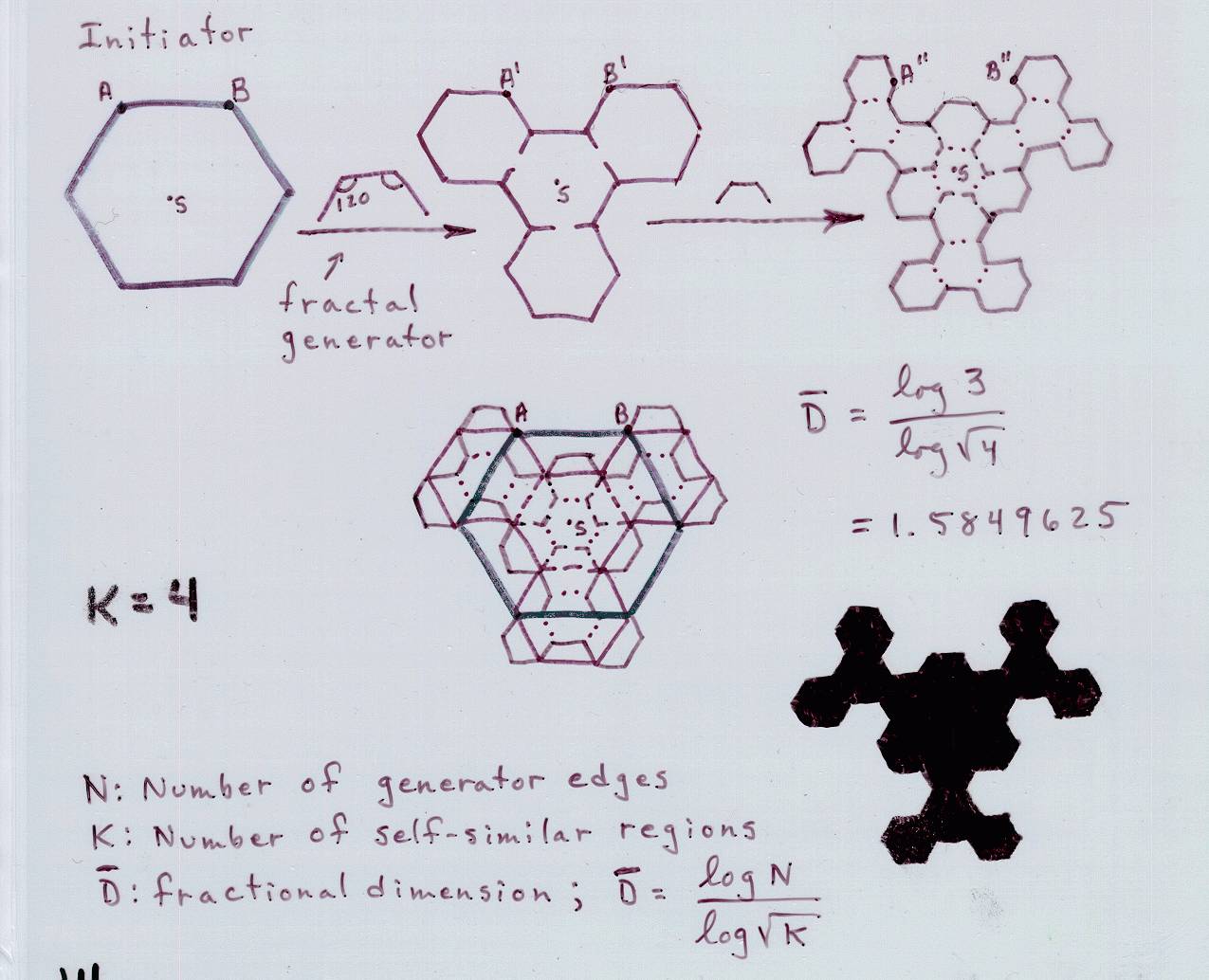
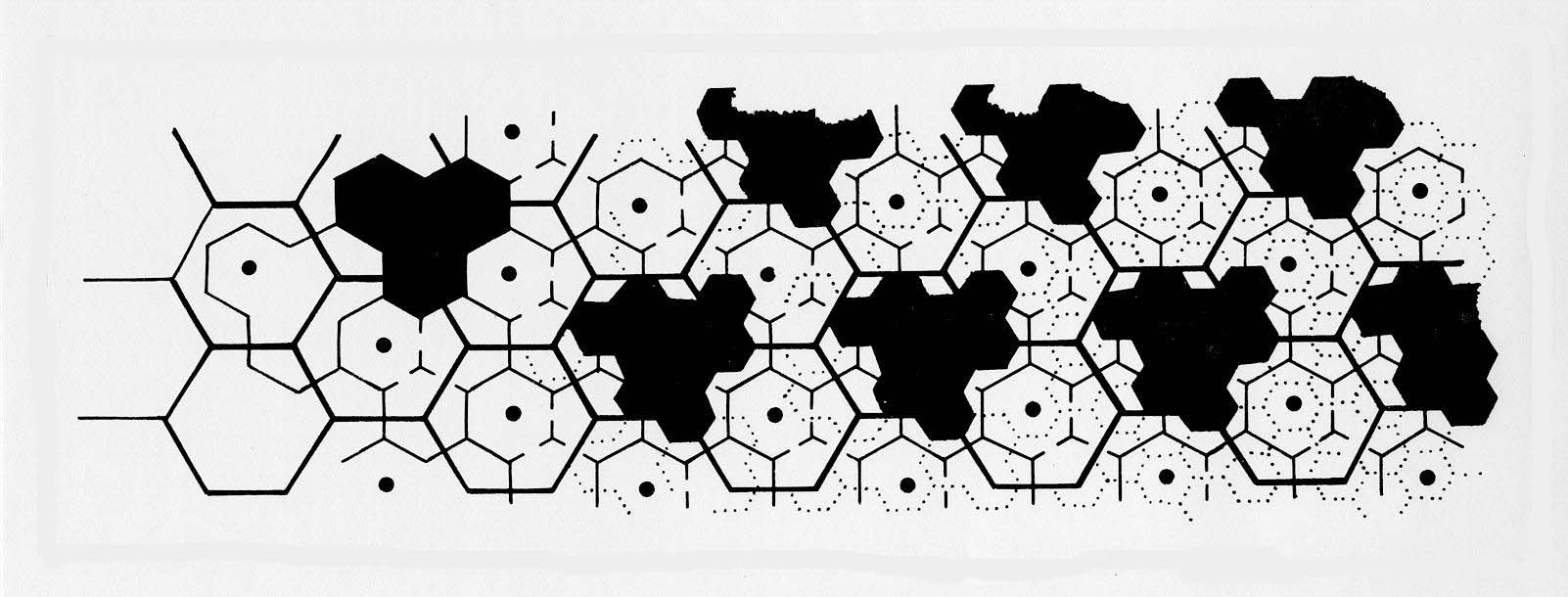
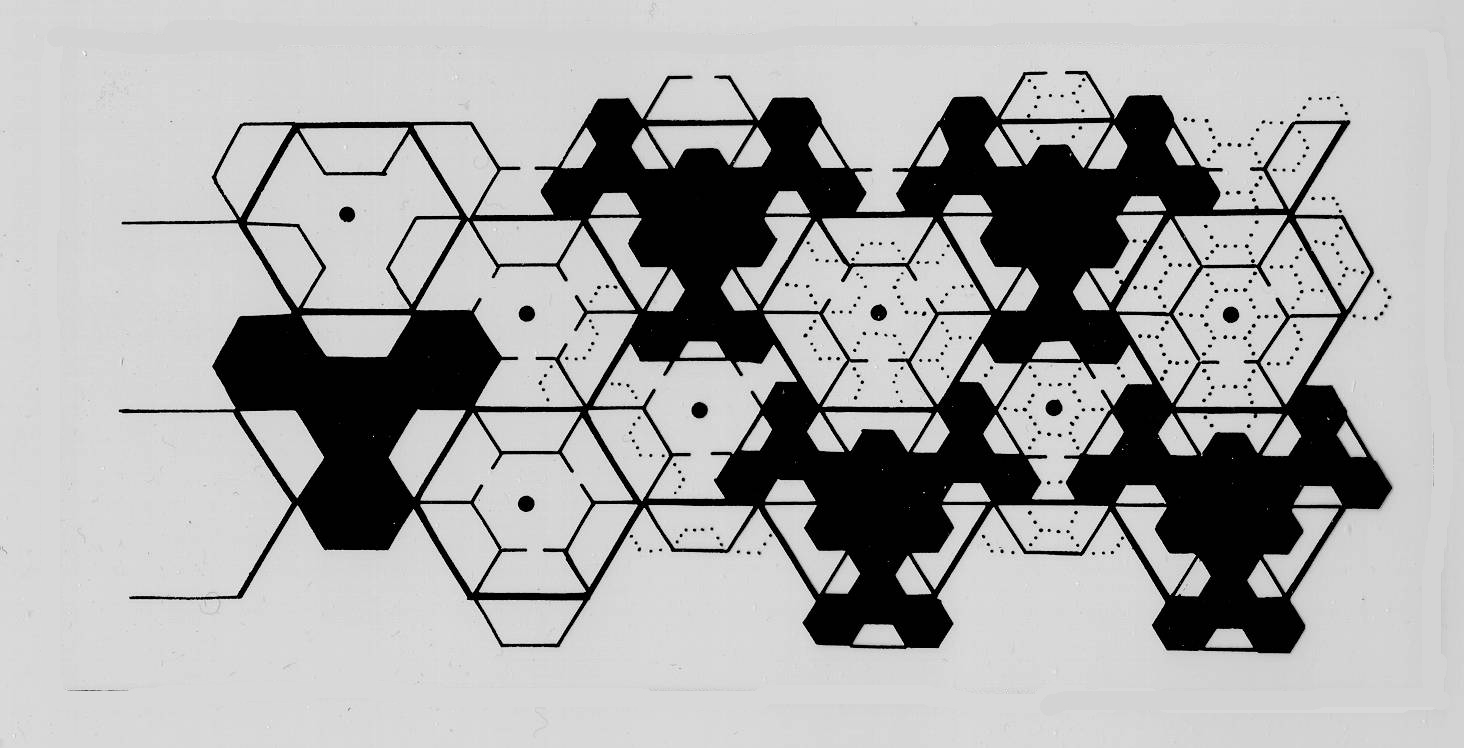
  • Complete determination of fractal generator shape, that will generate a complete hierarchy, based solely on number-theoretic properties of K.
  • Solution of sets of unsolved problems.
  • Fundamental theorems.
Slides:
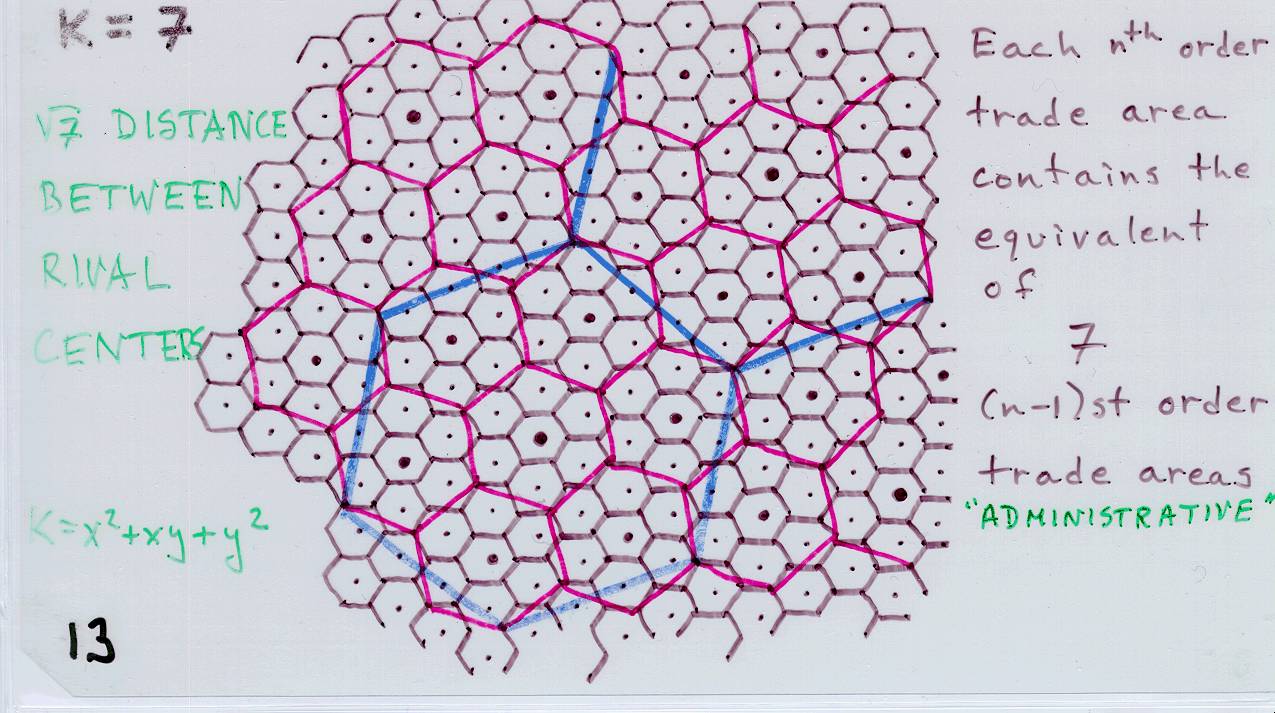
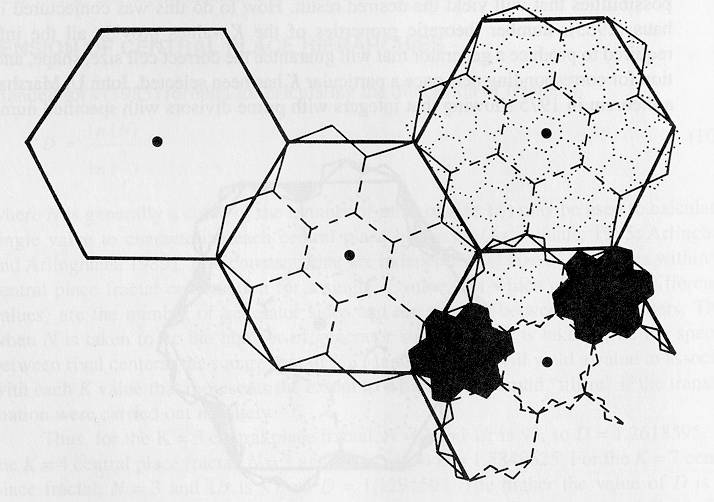
  • Sample of a higher K value to illustrate the difficulty in figuring out fractal generators to create the geometrically correct spatial hierarchy...Slide 17.
  • Oblique axes used to separate K values into a number of different subsets:
                  a.  along the y-axis and elsewhere
                  b.  along lines parallel to the line y=x
        Statements of key theorems...all on Slide 18.
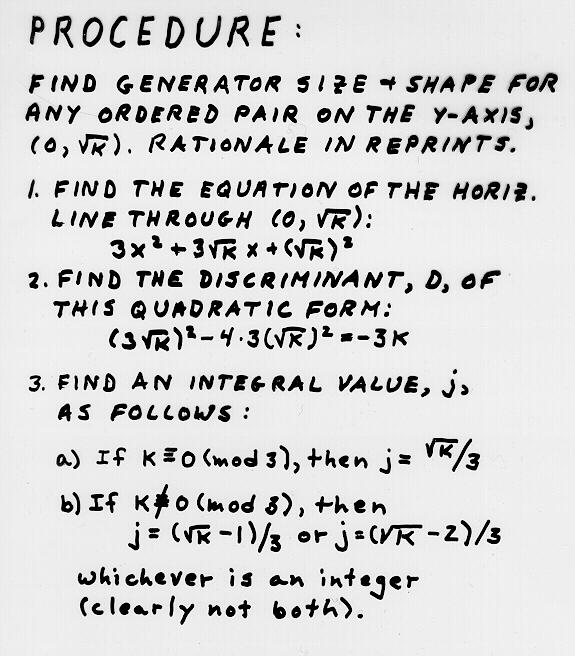
  • Procedure for working with K values on the y-axis; note, therefore that the square root of K is always an integer.
                  a.  equations of horizontal line parallel to y=x
                  b.  discriminant of the quadratic form
                  c.  the integral value, j, used to cross-cut the Diophantine equation.
          All on Slide 19.
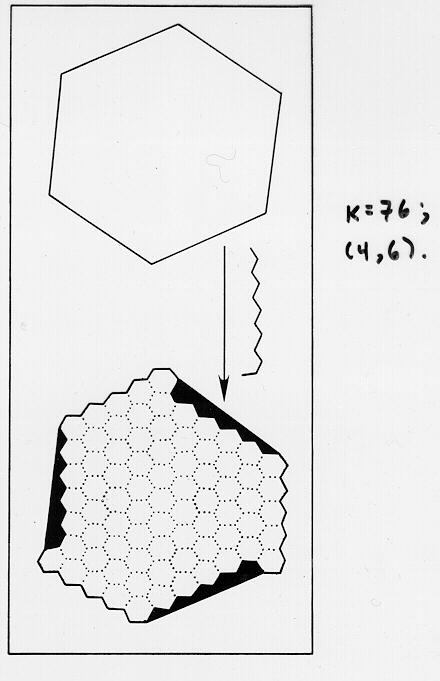
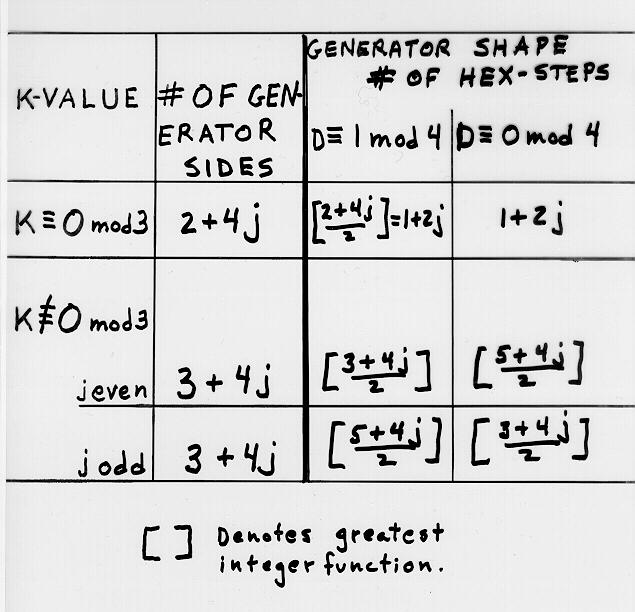
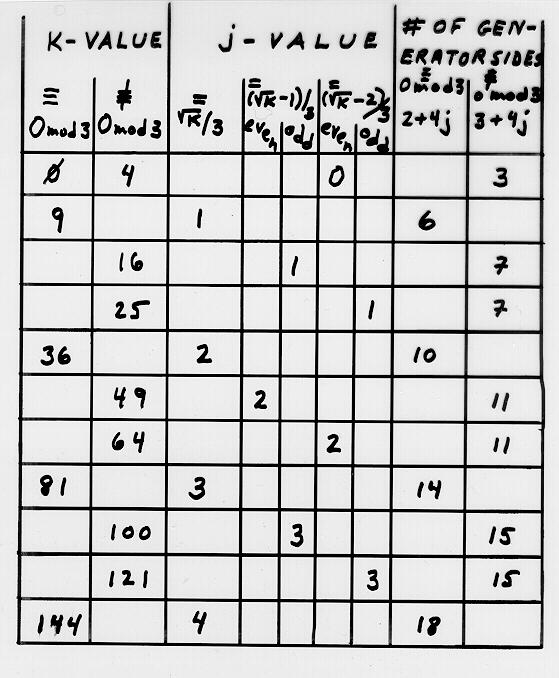
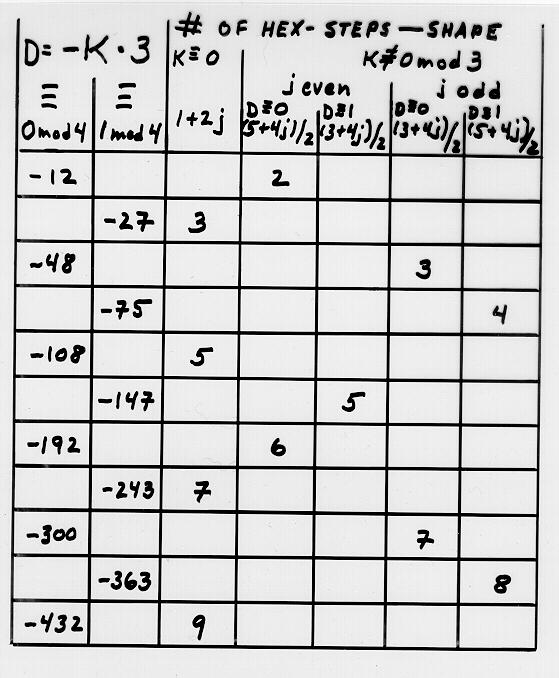
  • Chart illustrating how to determine the number of generator sides and the fractal generator shape (in terms of "hex-steps") simply from the number-theoretic properties of K.  That is, the entire central place hierarchy (its geometry) can be generated by understanding the "genetic" code embodied in K.  Slide 20.
  • Algebraic Table illustrating calculations in detail:  Slide 21, Slide 22.
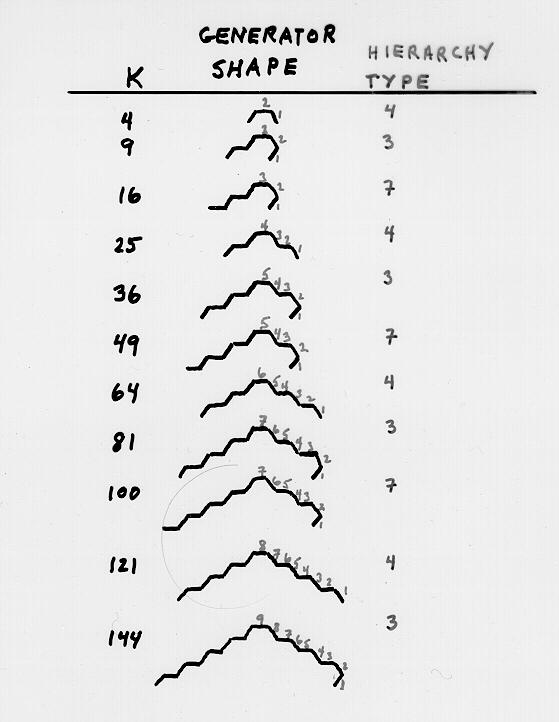
  • Geometric Table illustrating, a set of K values on the y-axis, the determination of generator shape and hierarchy type.  Slide 23.
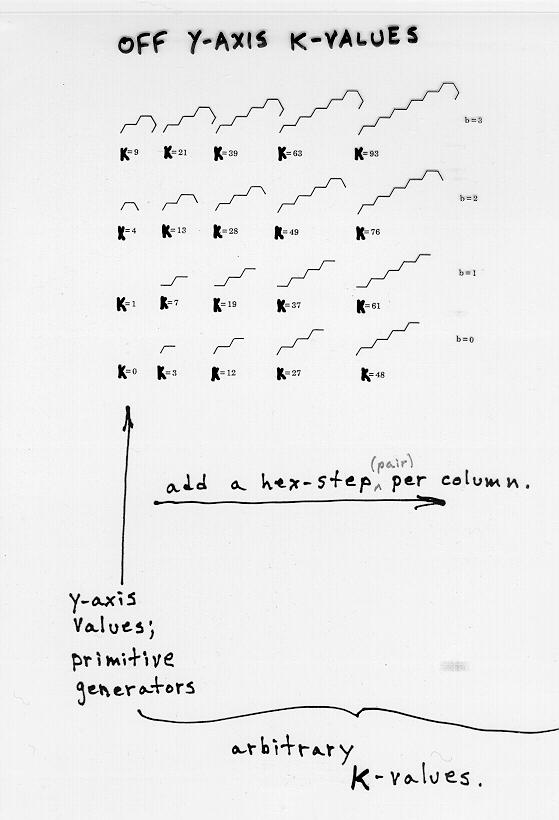
  • Geometric chart illustrating how to handle off-y-axis K-values (non-integral square roots).  Slide 24.
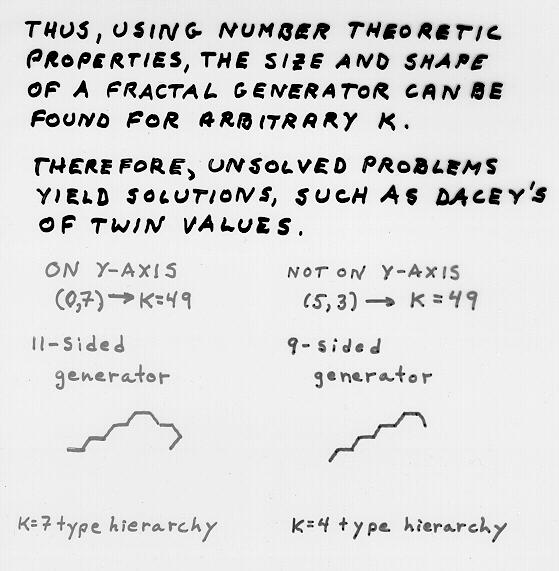
  • Fractal generators solve the problem (Dacey) of twin K-values:  49 can be generated by the pair (0,7) and (5,3).  The procedure separates these geometrically and generates the correct spatial hierarchies for each of them.  Slide 25.
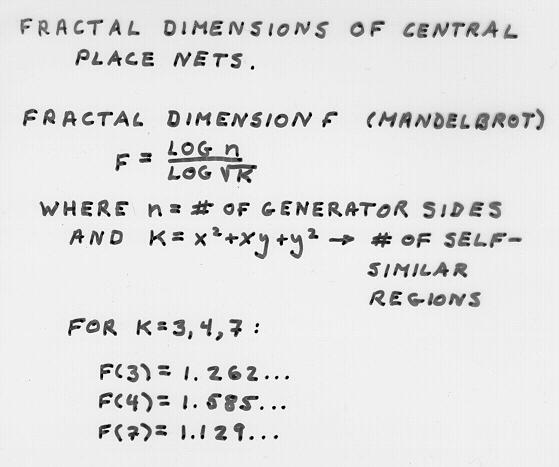
  • Fractal dimension formula used to calculate space-filling.  Slide 26.
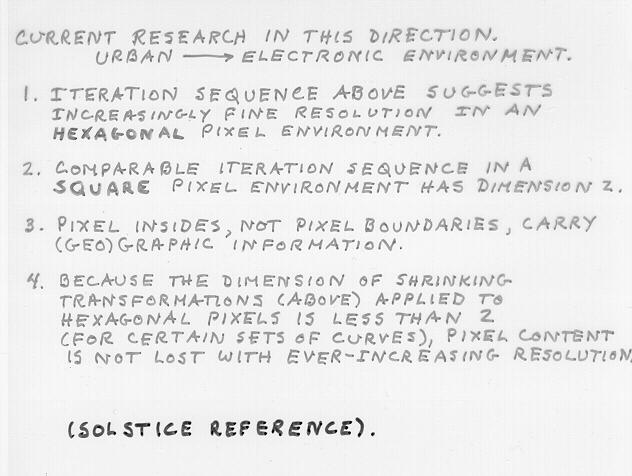
  • Some implications:  from the urban to the electronic environment. Slide 27.
  • Geometric suggestion of similar procedure for an environment of squares. Slide 28.

  •  
Ties to one set of basic geographic concepts:
centrality, hierarchy, scale, density, transformation, distance, orientation, geodesic, minimization, connection, adjacency 

Research Seminar/Lab Material
Troubleshooting of projects.


WEEK 8
 
Troubleshooting on an individualized basis.

 
Spring Break:  February 27-March 8, 1999

WEEK 9
Student Midterm Presentations--order of presentations is alphabetical according to uniqname.
 
beiselt
dkarwan
feec
gfiebich
huangh
jmeliker
mbrush
ninam
schlossb
zgocmen

WEEK 10
 
Conceptual Material:  Measuring Adjacency
  • Graph-theoretic adjacency and quantifying the join-count measure of clustering.
    • Given a set of polygons and two characteristics about them (say, B and W, as above).
    • There are four different adjacency patterns that can arise between adjacent polygons:
      • BB, BW, WB, and WW.
      Each of these patterns should occur, abstractly, 25% of the time.
    • On your map, use the query tool to select out all the polygons that exhibit the BW adjacency pattern (as above on the website).
    • Now, count the number of adjacency patterns that actually occur as BW:  thus, for example, polygon 1, which is B, is adjacent to 7 polygons that are W.  Then move to the next polygon and make a similar count.  Notice that this counts overlapping polygons and does not merge them as a single one.  This latter observation is critical--and, it makes for difficulty in doing the counting because the GIS table only puts in one copy of a polygon even though it might contribute more than once in the counting of the adjacencies.
    • Now, count the number of actual adjacencies in the entire map--call this number A.  Look at BW/A.  Similarly, look at WB/A and WW/A and BB/A.  If BW/A+WB/A=50% then the distribution is random.  If it is >50% then the dissimilar regions are clustered and autocorrelation is said to be negative.  If it is <50% then the similar regions are clustered and autocorrelation is said to be positive.
    • Often it is obvious from looking at a map whether or not there is positive or negative spatial autocorrelation.  But, if you need quantitative back up for such observations, this is one way to get it.  There are others, as well.  Indeed, you can even consider designing your own index and crafting theorems about that index (as we have done in a variety of situations above).
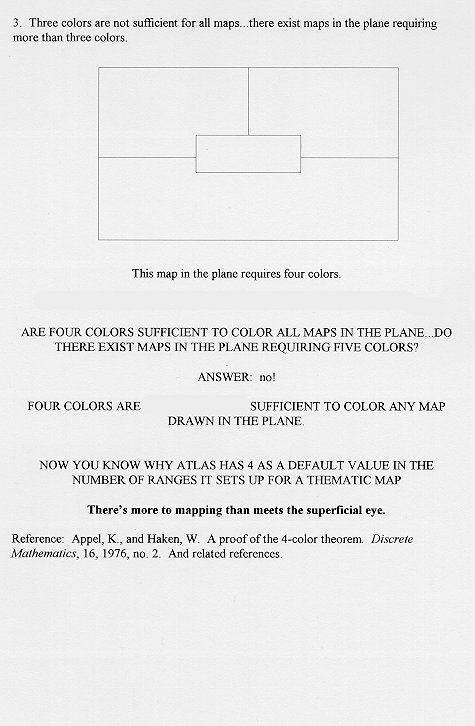
    • One way to estimate the number of adjacencies is to consider the "jig saw puzzle" model--corner pieces are adjacent to three other pieces; edge pieces are adjacent to five other pieces; and, interior pieces are adjacent to 8 other pieces.  This works well when the polygons are close to a grid pattern.  Notice that adjacency is considered to be across edges and vertices (unlike the Four Color Theorem in which adjacency is only across edges).  The reason for including the point-level adjacency is that the GISs use that when calculating "touching" polygons.
    An hypothetical situation:  given the following distribution of characteristics.  The entries B and W may be calculated by simple majority, by weighting the population in each cell according to, for example, economic indicators or others.  Count the adjacency pattern--number of WW, BW, WB, and BB adjacencies.  Each is expected 25% of the time, abstractly.
    W W W W W W W
    W W B B W W W
    W W B B B B W
    W W B B B B W
    Number the cells from upper left to lower right, reading from left to right.  Adjacency is measured across both lines and points.
     
    cell WW BW WB BB jig saw sum
    1 3


    3
    2 4
    1
    5
    3 3
    2
    5
    4 3
    2
    5
    5 4
    1
    5
    6 5


    5
    7 3