Protein NMR at the University of Michigan

NMR comes of age: Structure, dynamics and interactions of proteins/complexes up to 100 kDa.

Laboratory head: Erik R.P. Zuiderweg, Ph.D.
Professor, Biophysics Research Division, Dept. Biological Chemistry and Dept. Chemistry
(734) 936 3850 zuiderwe@umich.edu

General support: Alexander V. Kurochkin, Ph.D.
Assistant Research Scientist, Biophysics Research Division
(734) 763 0329  akur@umich.edu  

Link to  Biophysics  Link to Biological Chemistry   Link to Chemistry 

cycleStructure, dynamics, allosterics and function of Hsp70 Chaperones tth
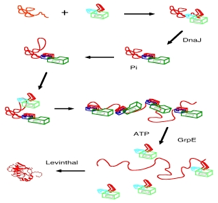
Hsp70 proteins mediate  trafficking, folding and refolding of proteins in all known cellular structures. Damage to these proteins is fatal; overexpression of these proteins is observed in stressed cells, such as in cancerous tissues. As such Hsp70's are a target for  the treatment of especially breast cancer. These Heat Shock Proteins are 70 kDa, and have a three domain structure: nucleotide-binding domain (44kDa), substrate binding domain (15-20 kDa) and C-terminal domain (15-20 kDa). The chaperone helps the refolding of proteins by binding and release cycles (see pic) driven by  an  allosteric mechanism. We use high field NMR in solution  (600 - 900 MHz) to study its structure, dynamics and interaction as a function of substrate, nucleotides and co-chaperones.    We are  working on large 60 kDa chaperone constructs in order to decipher the allosteric mechanism (see pic)  and to help develop drugs to suppress its activity as an aid in cancer therapy.
 
PICTORIAL INTRODUCTION TO THE CHAPERONES

Methodology Development in NMR detection of Molecular Dynamics
The understanding of protein function is incomplete without considering entropy, that is,  dynamics. In enzymes, the active site is often dynamic to be able to adept to ubstrate, transition conformation and product; for protein complexes, the  intermolecular interface sites are particularly dynamic to accomodate induced fits. Binding processes often involve perturbation of fast dynamical components,  contributing (sometimes to a dominant extent)  to the ligand binding entropy and hence ligand binding free energy (= affinity). The rate determining step  of enzymatic catalysis has in several cases found to be set by milli-micro-second dynamical processes of opening and closing the active sites (see pic).

NMR plays an important role in experimentally measuring dynamics in proteins at time scales ranging from seconds to pico seconds. Our mission is to develop and apply methods to describe what the motions actually are. It is of importance to distinguish, e.g., between concerted and non-concerted motion: these different modes have very different entropic and hence functional consequences.  Wo do this by  obtaining a  multitude of dynamic parameters on a restricted number of sites. The increased information density allows us to develop models for the dynamics and their entropic content. Our long-term aim is to achieve a better design of pharmaceuticals by incorporating dynamical information.

INTRODUCTION TO  NMR RELAXATION MEASUREMENTS FOR DYNAMICS

Publications of the Z-group

Research infrastructure
The group currently has 5 grad students and post-docs. We are the main users of a  4 channel Varian Inova 800 (January 1999) which will b eequipped with a cryo-probe in summer 2005. We have a  4 channel Bruker Avance 500 (December 1999) for the group's exclusive use and an old Bruker AMX 600.  We have partial access to a Bruker Avance  600 MHz system  with cryo-probe.  Up and coming: access to the Michigan Life sciences Corridor Bruker 900 MHz with cryoprobe  in summer 2005 (located at MSU).Thus, there is much instrument time available. We have a cluster of Silicon Graphics and  Linux-PC systems. We have two  labs for protein expression and purification, and have access to PCR equipment, shakers, and a New Brunswick fermentor.

The Lab
The laboratory is in the Biophysics Research Division, located in the Chemistry building in downtown Ann Arbor. The Division counts roughly 15 faculty and 60 students / postdocs, mostly interested in the  physical descriptions of biological phenomena. The NMR  infrastructure in Biophysics is second to none: in addition to our group there is a new solution NMR group (Al-Hashimi) working on nucleic acids mainly using RDC's, and there is a Biomolecular solid-state NMR group (Ramamoorthy) working on peptide-membrane interactions. Further, there are two X-ray groups, two single-molecule spectrocopy / manipulation groups, and several computational groups. Many groups are involved in interdisciplinary collaborations.

Its location
Ann Arbor is a friendly and hilly town with much culture and local recreational possibilities in the parks along the Huron river. The town is extremely cosmopolitan with large city amenities but without large city problems. The population is around 150,000, from which roughly 40,000 are associated with the University of Michigan -- so, it is a student town, but there are plenty of "normal" people too.  Michigan's  international  airport, a Northwest  hub, is within 40 minutes drive. Michigan weather is moderated by the Great Lakes - never really cold, never really hot. Summer, fall and winter are  nice. Michigan's "up-north"  on Lake Michigan offers beautiful scenery, and has plenty of summer and winter recreation. Chicago is a four-hour drive by either train or car.

Biomolecular NMR tutorial.

more pictures

Nmr relaxation pulse sequences for quick assessment of conformational exchange
 
Varian sequences in simple  programming style