|
Scott
D. Campbell (home page)
Associate Professor of Urban Planning
[former Director of Doctoral Studies: 2004 - 2012; 2017 - 2019]
Taubman College
of Architecture + Urban Planning
University
of Michigan
2000 Bonisteel Blvd., Ann Arbor MI 48109-2069
sdcamp@umich.edu
2352 A&AB • (734) 763-2077
modified:
Thursday, March 7, 2024
NOTE: as of 2021, Prof. Lesli Hoey is the new Director of Doctoral Studies. Please direct your queries to her. Thank you. |
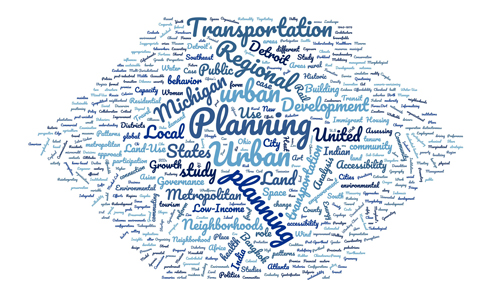
a wordcloud graphic of recent Michigan planning dissertations (click for larger image) |
An Informal Letter to Potential Applicants to the Ph.D. in Urban & Regional Planning at the University
of Michigan
Thank you for your interest in the doctoral planning
program at the University of Michigan! For over 55 years, students have come to Ann Arbor to engage in the
intellectually demanding and richly interdisciplinary environment of doctoral
planning studies. (Over 200 students have received their PhD in planning from our program. A list of recent graduates and their dissertation titles is at the bottom of this page.) We have a large and diverse planning faculty who welcome the opportunity to collaborate with doctoral students. Students take
courses both in planning and in a wide range of disciplines across campus. Graduates
work in universities, government, non-profits and the private sector, both in
the U.S. and around the world. Graduates have gone on to teach and do research at such institutions as Wisconsin, University of North Carolina at Chapel Hill, Brown, Rutgers, Oregon, Northeastern, University of Baltimore, Iowa, Iowa State, UC Berkeley, the University of Colorado, Cardiff, University of Illinois-Chicago, Wayne State, Washington University in St. Louis, Arizona State, Ohio State, Florida State, Waterloo, University at Buffalo, University at Albany, Virginia Tech, University of Maryland, University of Georgia, University of Texas, Chalmers University of Technology (Sweden), Trinity and Maymouth Universities (Ireland), University of Haifa (Israel), University of Bergen (Norway), Chulalongkorn University (Thailand) and other universities around the world. The curriculum integrates analytical methods,
research design, a rigorous understanding of urbanization dynamics, and an
examination of broader social processes and policies. Students address complex
systems that typically encompass an array of spatial, environmental, social,
political, technical, and economic factors. The emphasis is on theory, analysis
and action. Here is a link to the research interests of our current doctoral students.
Should I apply for the Ph.D. or the MURP?
- The Urban and Regional Planning Program offer two graduate degrees: the two-year professional MURP (Master of Urban Planning) degree, and the four-year Ph.D. Almost all students who apply to the Ph.D. already have their masters (or are currently completing their masters) in urban planning or a related field (such as public policy, environmental studies, geography, architecture, social work, economics, civil engineering, etc.). Applicants with other master’s degrees will be considered as well.
- For almost all applicants without a masters, applying to the MUP program is the appropriate choice. (Note: in rare circumstances, some exceptionally well-prepared applicants -- with just a bachelors degree -- may already be interested in pursuing the Ph.D. and choose to apply directly to the Ph.D. program. Please contact the admissions office if you have questions about this academic path.)
- If the Masters of Urban & Regional Planning (MURP) is a better fit with your interests and academic background, please see this link to the MURP program.
Annual Deadline:
- The deadline for applications is
January 15. (to begin classes in the fall).
- Can I still apply if I miss the January 15 deadline? Do contact the admissions staff if you miss the January 15 deadline to make sure they are still accepting applications. We are sometimes able to also review applications received in late January. The doctoral admissions committee typically reviews application materials starting in late January, with most decisions about admissions made by late February/early March. The admissions season concludes by April 15.
Advice for your application:
- Admission is highly competitive. We are able to offer all of our
incoming doctoral students four years of funding (tuition, stipend, health
insurance) through a combination of teaching assistantships, research
assistantships and fellowships. This includes funding over the summer. (Of course, incoming students also may seek
additional aid through outside fellowships.) The goal is to complete the doctoral program in four years (though additional funding opportunities exist for studies extending beyond four years).
- The application
process is done on-line, and all our printed materials are also available
on the web.
- IMPORTANT: Please note that you do NOT need to arrange a faculty sponsorship of your dissertation research project ahead of time NOR do you need to identify a specific
faculty member here as a potential advisor as part of your application process.
(You are applying to the program as a whole, not to work specifically
with a single faculty member. You may later work closely with one or more
faculty members on funded research projects, but you do NOT need to arrange
that ahead of time.) That said, we do ask you, in the application materials, to identify at least two Urban and Regional Planning faculty who could potentially serve as your mentors and explain how their scholarly interests or methodologies align with your intellectual and career ambitions.
- Four years of funding are offered to all our incoming doctoral students regardless of their areas of specialization.
- For the doctoral application process, we place
particular importance on past academic performance (especially in master's
level programs), your letters of recommendation (especially from faculty, including from your most recent degree program), and
the statement of purpose. The statement of purpose is a vital component of
your application. Explain how you arrived at the decision to pursue a Ph.D. in
urban and regional planning, what you plan to do during the course of your
studies, and how you hope to use your doctoral education in planning. In
particular, discuss the intellectual and policy challenges that you hope to
address in your doctoral studies, outline the methodological skills you plan to
pursue, and discuss tentative dissertation research topics. (There are
no requirements for length. The typical length is 2+ single-spaced pages.)
- We do NOT require the GRE. (We dropped the GRE requirement both due to problems with the test and because of the cost and logistical burdens, especially for international students.)
- Regarding English language tests: Yes, we require the TOEFL or IELTS, or similar test results. (Exception:
"Applicants who have earned or will earn a Bachelor or Master degree
from an institution where the language of instruction is English, exclusively,
are exempt from submitting an Official English Proficiency Score. Verification
from the school may be required."). Please see the Rackham Graduate School page for more information.
- We do not require an interview as part of the admissions process. Of course, we would be happy to informally meet with you at any time throughout the year and have you speak with both faculty and other doctoral students if you will be in the Ann Arbor area. Please contact Lisa Hauser (contact info below) to help schedule a visit.
- For a more detailed discussion of the application process, please see the "How to Apply" web page.
- The Ph.D. in Urban and Regional Planning is one of two doctoral degree programs in the Taubman College of Architecture and Urban Planning. The other doctoral program is the Ph.D. in Architecture.
For more information, please see:
We look forward to reading your application materials in January. |
 |
A list of recent graduates (since 2014) and their dissertation titles
- Vanka, Salila: Public Space and Life in an Indian City: The Politics of Space in Bangalore
- Rajkovich, Nick: Assessing and Reducing Exposure to Heat Waves in Cuyahoga County, Ohio
- Lee, Wonhyung: Critical Perspectives on Local Governance: The Formation of Business Improvement Districts (BIDs) in Low-Income Immigrant Neighborhoods of Los Angeles
- Nakamura, Shohei: Land tenure, politics, and perception: a study of tenure security and housing improvement in Indian slums
- Owens, Kate: Negotiating the City: Urban Development in Three Tanzanian Cities
- Mills, Sarah: Preserving Agriculture through Wind Energy Development: A Study of the Social, Economic, and Land Use Effects of Windfarms on Rural Landowners and Their Communities
- Epstein, David: Fostering Participation and Capacity Building with Neighborhood Information Systems
- Skuzinski, Tom: Risk, Rationality, and Regional Governance
- Shake, Josh: Privatizing Urban Planning and the Struggle for Inclusive Urban Development: New Redevelopment Forms and Participatory Planning in São Paulo
- Meyer, Justin: Art museums and their connection to neighborhood change: A case study of the Portland Art Museum in Oregon
- Williams, Jennifer: Understanding Low-Income Residents’ Sense of Community in Post-Aparthead Housing Developments in South Africa
- Weinreich, David: Transportation Planning & Finance Through Multi-Jurisdictional Collaboration: Regional Transportation Planning in an Era of Decentralized Government
- Stults, Missy: Planning to be Prepared: Assessing Local Level Planning for Climate Change in the United States
- Seymour, Eric: Federal Financial Institutions, Foreclosure, and the Fortunes of Detroit’s Middle- and Working-Class Neighborhoods
- Rugkhapan, Napong: Technopolitics of Historic Preservation in Southeast Asian Chinatowns:Penang, Bangkok, Ho Chi Minh City
- Rivera, Danielle: Questioning as We Walk: Case Analysis of Community Organizing in Rio Grande Valley Colonias
- Trivers, Ian: Mobilizing the High Line
- Mcaslan, Devon: Walking, Transit Use, and Urban Morphology in Walkable Urban Neighborhoods: An Examination of Behaviors and Attitudes in Seattle Neighborhoods
- Fishelson, James: Planning for a Shared Automated Transportation Future
- Cooper-McCann, Patrick: The Promise of Parkland: Planning Detroit’s Public Spaces, 1805-2018
- Kayanan, Carla Maria: Building Cities Like Startups: Innovation Districts, Rent Extraction, and the Remaking of Public Space
- Yan, Xiang "Jacob": Redefining the Value of Accessibility: Toward a better understanding of How Accessibility Shapes Household Residential-location and Travel Choices
- Singer, Matan: How Affordable are Accessible Locations? Housing and Transportation Costs and Affordability in U.S. Metropolitan Areas with Intra-Urban Rail Service
- Koscielniak, Michael Roman-John: Ground Forces:Dirt, Demolition, and the Geography of Decline in Detroit, Michigan
- Gauger, Bri: Urban Planning and its Feminist Histories
- Batterman, Joel: A Metropolitan Dilemma, Regional Planning and Governance in Detroit, 1945-1995
- Pfaff, Rob: Regions, Race, Rail and Rubber: An Analysis of How Transportation Planning Decisions Contributed to Regional Segregation, 1922 – 1973
- Borsellino, Michael: Discursive Approaches to Gentrification Studies: Excavating the Market-Led Paradigm
- Sanga, Naganika: Federal Incentives, State Preemptions, and Local Politics: Implementing Inclusionary Housing Policies in India and the United States
- Bettis, Eric: If They’re Riding It, We’re Not Voting for It: Assessing the Role of Racial Threat on Voter Support for Regional Public Transit in Atlanta and Detroit
- Judelsohn, Alexandra: Planning Resettlement: Assessing Governance Gaps in the U.S. Resettlement Program
- Son, Seulgi: Transformative Pathways from Farm to Table: Opportunities and Challenges for Public Food Procurement to (Re)build Regional Food Systems
- Dobie, Sarah: Integrated Planning for Climate Resilience and Food Security: An Analysis of Urban Food System Resilience Planning in U.S. Cities
- Taru: Institutional Hybridity for Effective and Plural Disaster Response: On How to Govern a Polycrisis
- Andoh, Nana-Yaw: Informal Settlements: The Intersection of Social Networks, Livelihoods, and the Built Environment in Johannesburg, Nairobi, and Accra