TEACHING
2014
This page lists and describes courses I teach. Wolverine Access and the online LS&A course guide are good sources for general course information.
Also visit the "Resources" page for teaching and learning-related information.
Regular Courses
The following are descriptions of courses I frequently teach.
POLSCI 101: Introduction to Political Theory
-
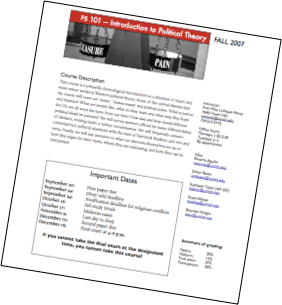
This course is a primarily chronological introduction to a selection of major and some minor works in Western political theory. Some of the central themes that the course will cover are ‘justice,’‘ human nature’ and political action. What is justice, and injustice? What are people like, what do they want and what may they hope for? Do we all want the same from our lives? How may and how should different political ideals be pursued? We will survey answers offered by many different kinds of thinkers, writing under a variety circumstances. We will frequently connect contemporary political questions with the texts of historical thinkers, and vice and versa. Finally, we will pay attention to what our theorists themselves are up to: how they argue for their views, whom they are addressing, and how they can be interpreted.
POLSCI 409: Twentieth-Century Political Thought
-
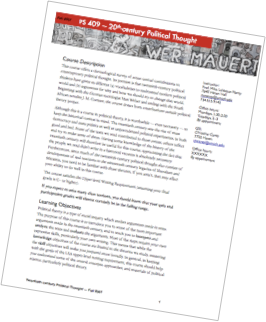
This course offers a chronological survey of some central contributions to contemporary political thought. Its premise is that twentieth-century political thinkers have given us different (a) vocabularies to understand modern political world and (b) arguments for why and how we should try to change that world. Beginning with the German sociologist Max Weber and ending with the South African novelist J. M. Coetzee, the course draws from contributions outside political theory proper.
-
POLSCI 603: Modern Political Thought
-
This graduate seminar covers what we consider the modern period: roughly 1600-1900. It generally begins with Hobbes and ends with Nietzsche. It is a speedy survey, but over the last several of years I have tried to slow down a bit by teaching it as a two-part courses, selecting a smallish number of theorists for a more careful attention than we are usually able to give them.
Courses in Fall 2013
POLSCI 101 Introduction to Political Theory
POLSCI 493 Political Science Senior Honors Proseminar
POLSCI 609 Twentieth-century Political Thought
Courses in Winter 2014
POLSCI 494 Political Science Senior Honors Proseminar
Updated Jan 8, 2014

Unless otherwise indicated, this website is licensed under a Creative Commons Attribution-Noncommercial -Share Alike 3.0 United States License.
Copyright © 2009-2013 Mika LaVaque-Manty.

101: Introduction to Political Theory
190: First-year Seminar
-
 Fall 2003 (“Leadership and Democracy”)
302: Modern Political Thought
-
Winter 2003
381: Political Science Research Design
402: Liberalism and Its Critics
409: Twentieth-century Political Thought
481: Junior Honors Proseminar
495: Undergrad Seminar in Political Theory
601: Philosophy of Social Science
603: History of Political Thought: Modern
609: Twentieth-century Political Thought
701: Selected Theorists
-
Fall 2002 (Immanuel Kant)
702: Selected Topics
-
Fall 2005 (“Liberalism and Its Critics”)