

1. Regulation of molecular motors.
Regulation of molecular motors is an important cellular problem as motility in the absence of cargo results in futile ATP hydrolysis. When not transporting cargo, Kinesin-1 is kept inactive due to a folded conformation that allows auto-inhibition of the N-terminal motor by the C-terminal tail. Using the quantitative method FRET stoichiometry to study fluorescent protein (FP)-labeled kinesin heavy chain (KHC) and kinesin light chain (KLC) subunits in live cells, we showed that two regions of Kinesin-1 are required for auto-inhibition and that two conformational changes occur upon activation. |
 |
 |
| How is Kinesin-1 activated for microtubule-based transport? The simplest model of Kinesin-1 activation posits that cargo binding to non-motor regions relieves auto-inhibition. However, cargo binding is not sufficient for motor activation. Rather two binding partners, one of KHC (fasciculation and elongation protein zeta (FEZ1)) and one of KLC (JNK-interacting protein 1 (JIP1)), are required to activate Kinesin-1. |
| |
|
Movies 1-3: Live cell microtubule binding assay of inactive and cargo-activated Kinesin-1. COS cells expressing the indicated Kinesin-1, JIP1 and FEZ1 proteins were transiently permeabilized with Streptolysin O (SLO), washed, and then AMPPNP was added. When expressed alone, KHC-mCit is active and cannot be released from microtubules after addition of AMPPNP (Movie 1). When the Kinesin-1 holoenzyme is recreated by coexpression of KHC-mCit + KLC-mECFP, Kinesin-1 is inactive and cannot be locked on the microtubules (Movie 2). Expression of either JIP1 or FEZ1 alone is not sufficient to activate Kinesin-1 (KHC-mCit + KLC-mECFP) (not shown). However, coexpression of Kinesin-1 with both JIP1 and FEZ1 results in an active Kinesin-1 (KHC-mCit + KLC-mECFP) molecule that can be locked on microtubules upon addition of AMPPNP (Movie 3).
References:
Cai D, Hoppe AD, Swanson JA, Verhey KJ. Kinesin-1 structural organization and conformational changes revealed by FRET stoichiometry in live cells. J Cell Biol. 2007 Jan 1;176(1):51-63.
Blasius TL, Cai D, Jih GT, Toret CP, Verhey KJ. Two binding partners cooperate to activate the molecular motor Kinesin-1. J Cell Biol. 2007 Jan 1;176(1):11-7. Hackney DD. Jump-starting kinesin. J Cell Biol. 2007 Jan 1;176(1):7-9. |
2. Microtubule post-translation modifications as road signs for motor protein transport.
Once kinesin motors are activated for microtubule-based transport, how do they know where to go? Especially for polarized transport, where a cargo is delivered to a specific subcellular locale such as an axon or dendrite, this question remains unanswered. We showed that post-translational modifications (PTMs) of the microtubules can direct Kinesin-1 transport of JIP1. |
 |
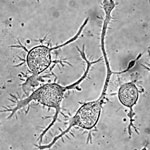
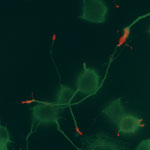
Movie 4: EYFP-JIP1 is continuously delivered to the tips of neurites by Kinesin-1. EYFP-JIP1 was expressed in differentiated CAD cells. The EYFP-JIP1 fluorescence at the tip of the neurite was bleached (white boxed region) using a 515nm laser at high power and then images were collected for ~ 10 min at low laser power. Imaging was performed on an Olympus FV-500 confocal microscope at 37°C. |
References:
Reed NA, Cai D, Blasius TL, Jih GT, Meyhofer E, Gaertig J, Verhey KJ. Microtubule acetylation promotes Kinesin-1 binding and transport. Curr Biol. 2006 Nov 7;16(21):2166-72
Bulinski JC. Microtubule modification: acetylation speeds anterograde traffic flow. Curr Biol. 2007 Jan 9;17(1):R18-20. |
3. Live-cell imaging of single Kinesin-1 motors
We set out to investigate the in vivo motile characteristics of the fundamental unit of transport: a single Kinesin-1 motor moving along microtubule tracks. We expressed a truncated version of KHC labeled with three tandem copies of the monomeric FP Citrine (KHC(1-891)-3xmCit) in COS cells and imaged their motility by single-molecule TIRF microscopy. Individual Kinesin-1 motors move in vivo with an average speed of 0.78 ± 0.11 mm/s and display an average run length of 1.17 ± 0.38 mm. Thus, Kinesin-1’s speed and processivity in cells are not up-regulated or hindered by macromolecular crowding as compared to in vitro measurements. |
|
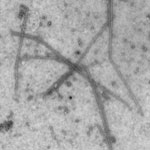
Movie 5: Single molecule tracking by TIRF microscopy of KHC(1-891)-3xmCit motors expressed in a live COS cell. The image series was offline processed and color coded: green = single KHC(1-891)-3xmCit motors and red = microtubule tracks. The yellow line indicates the outline of the COS cell. The frame rate is 30 Hz. |
References:
Cai D, Verhey KJ, Meyhofer E. Tracking Single Kinesin Molecules in the Cytoplasm of Mammalian Cells . Biophysical Journal, in press. |