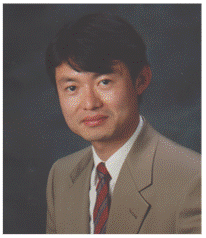
Katsuo Kurabayashi, Ph.D.
Professor
Department of Mechanical Engineering
Department of Electrical Engineering & Computer Science
2272 G.G. Brown Lab
Voice: (734) 615-5211
Fax: (734) 647-3170
Click Here for
Kurabayashi Lab Website
Education
B.S. in
Precision Engineering, University of Tokyo, 1992
M.S. in
Materials Science (Physics of Solids), Stanford University, 1994
Ph.D. in
Materials Science with Electrical Engineering minor, Stanford University,
1998
Professional Experiences
Professor, Department of
Mechanical Engineering, University of Michigan, 2012 - present
Department of Electrical Engineering
& Computer Science, University of Michigan
Macromolecular Science and Engineering,
University of Michigan
Associate Professor,
Department of Mechanical Engineering, University
of Michigan, 2006 - 2012
Department of Electrical Engineering
& Computer Science, University of Michigan
Assistant Professor, Department of Mechanical
Engineering, University of Michigan, 2000 - 2006
Assistant Professor, Department of Electrical
Engineering & Computer Science, University of Michigan, 2004 - 2006
Research Associate,
Department of Mechanical Engineering, Stanford University, 1999-2000
Initiated
collaboration with
Summer
Intern, Components Research, Intel
Corporation, Santa Clara, CA, June 1997-Sept. 1997
Developed
an experimental technique for measuring thermal conductivities of novel
dielectric layers and thermal resistance at metal/dielectric interfaces as a
technology transfer from academia to industry. The measured thermal parameters
are being used in thermal simulations of the next-generation intel microprocessors.
Research
Assistant, MTMC Lab and Stanford Solid
State Electronics Lab, Stanford University, 1994-1998
Managed
proposal writing, reporting, and company site visits for Semiconductor Research
Corporation (SRC) contract 357 (packaging sciences). The contract supported the
dissertation research on the thermal transport properties of polymer films, and
was chosen by the member companies as a 1998 compelling reason for joining the SRC.
Honors and Awards
Semiconductor Research
Corporation (SRC) Best Paper Award, TECHCON '98, September 1998
International VLSI Multilevel
Interconnection Conference Outstanding Paper Award, October 1998
National Science Foundation
CAREER Award 2001-2005
University of Michigan Robert Caddell Memorial Award 2004-2005
Co-author of SPIE Best Student
Paper Award, Optics East 2004 (with Yi-Chung Tung), October 2004
Biographical Information
Dr. Kurabayashi received his B.S. degree in Precision Engineering at
the University of Tokyo in 1992 and his M.S. and Ph.D. degrees in Materials
Science and Engineering with Electrical Engineering Minor from Stanford
University, in 1994 and 1998, respectively. Upon completion of his Ph.D.
program, he was hired as a Physical Science Research Associate with the
Mechanical Engineering Department at Stanford University and participated, for
a year, in a DARPA funded project aiming to develop MEMS-based microfluidic
technology for future IC cooling. He is Professor of Mechanical Engineering at
the University of Michigan, investigating novel actuator and micro-mechanism
designs for MEMS, multi-physics domain analysis of RF MEMS, nano-scale thermal
energy transport in electronic devices and MEMS structures, and polymer-based
microfabrication. He authored and co-authored more than 40 journal and
conference papers, two of which received a best paper award (Semiconductor
Research Corporation Best Paper Award in 1998, and International VLSI
Multilevel Interconnection Conference Outstanding Paper Award in 1998). He is a
recipient of the 2001 National Science Foundation (NSF) Early Faculty Career
Development (CAREER) Award for his contribution to a study of thermal energy
transport in micromachined polysilicon
structures at high temperatures. Dr. Kurabayashi has given seminars as an invited speaker at
industrial laboratories, such as Xerox Palo Alto Research Center and Lucent
Technologies Bell Laboratories between 1999 and 2001 and serves as member of
the NSF panel committee for Nanoscale Exploratory Research (NER) Program in
2001.
At the University of Michigan, Dr.
Kurabayashi has developed a graduate-level course on MEMS. This course covers
highly interdisciplinary teaching materials such as semiconductor physics,
micromachining, transducer fundamentals, thin-film mechanics, and heat
transfer, which are all necessary for designing the modern MEMS-based sensors
and actuators. Students from a variety of graduate programs, including Aerospace
Engineering, Biomedical Engineering, Chemical Engineering, Civil Engineering,
Electrical Engineering and Computer Science, Mechanical Engineering, and
Physics, take this course and are asked to make a team effort to propose a new
MEMS design using the knowledge obtained through the course. The course project
has resulted in two publications and one provisional U.S. patent since the
course started in winter, 2000. He has also developed a research laboratory in
the Mechanical Engineering Department, Micro Systems
Technology and Science Lab (MSTS Lab), which is currently
available full-time for dynamic, thermal, and electrical design and
characterization of MEMS and electronic devices.