This is a full-text html version of the following article from Pleistocene Coalition News posted 12-14-2010:
Return to Phi in the Acheulian
THE GOLDEN FLUTE OF GEISSENKLOSTERLE
Preview of APLIMAT 2011 paper
By John Feliks
a
b
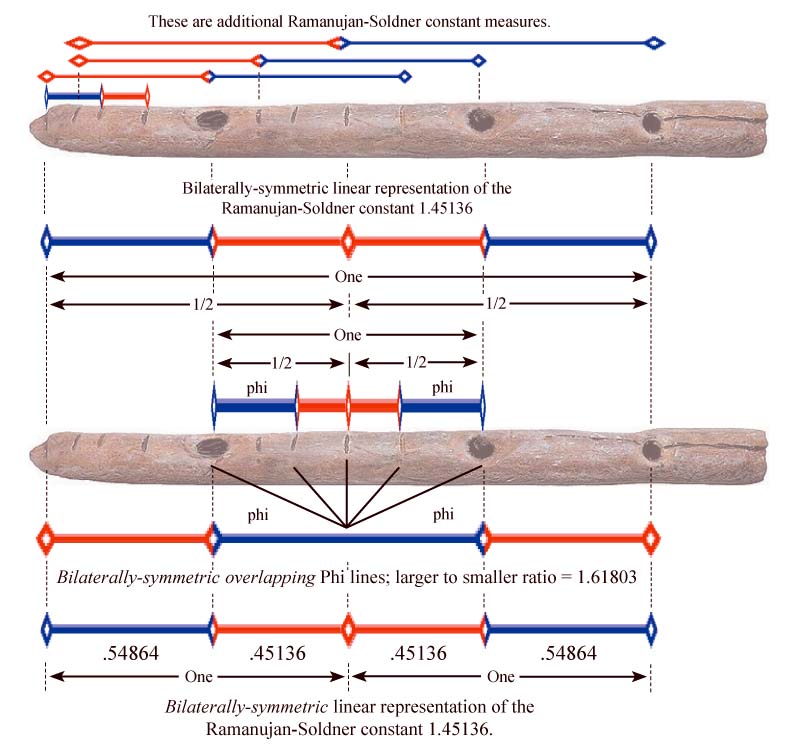
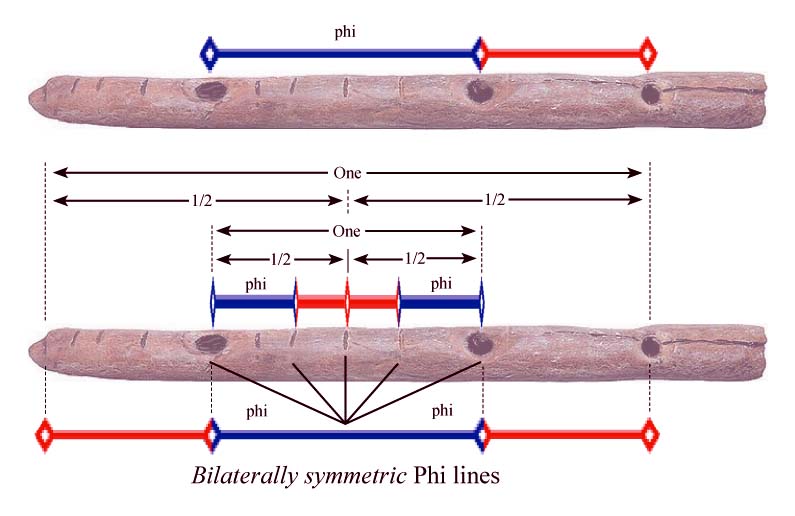
Fig. 1. The 35,000-year old swan bone
flute from Geissenklösterle, Germany, and two of several hundred studies of
mathematical constants in early artifacts: (a) the golden ratio or phi in
bilateral symmetry (Note: the smaller units, though not indicated here, are
also phi); (b) linear representation of the Ramanujan-Soldner constant in
bilateral symmetry as it relates to phi. Disclaimer: The author is not a mathematician
but uses the mathematics of ancient artifacts to prove that human cognition
does not evolve but has remained the same over hundreds of thousands even
millions of years time. Geissenklösterle flute replica photo by Jose Manuel
Benito; public domain. All geometric studies © John Feliks 2010.
At the XV UISPP Congress, Lisbon 2006, two 56-slide programs on
the mathematical and graphic design capabilities of Homo erectus people were presented. At the
time of this writing the first of these programs, The Graphics of Bilzingsleben (evidence demonstrating
that human intelligence does not evolve), has been held back from publication
for over four years. After some resistance, however, the second paper, Phi in the Acheulian—without the
benefit of the Part 1 introductory paper—was published in 2008.1 In that paper, the technique of ‘phi-based
conceptual units’ was introduced as a means to prove early human intelligence extending
as far back as 400,000 years and much earlier. It was demonstrated that works
of Homo erectus feature unambiguous use of the golden ratio or phi (decimal
equivalent, 1.618), to utter perfection rivaling even the work of Leonardo da Vinci
who is commonly cited for his use of the golden ratio.
In 2010, SCIENAR mathematics group, published a follow-up, Phi-based conceptual units: Pushing math origins back to the
Acheulian age.2
Here, through the 35-40,000-year old swan-bone flute from Geissenklösterle, Germany, I offer more evidence that
the golden ratio and perhaps other mathematical constants were well-understood by
our early ancestors throughout the Lower, Middle, and Upper
Palaeolithic. Clearly, we are talking about more than a musical
instrument here, and perhaps equally, a “mathematical instrument,” in its own
time and way as sophisticated as a slide rule.
1 Feliks, J. 2008. Phi in the
Acheulian: Lower Palaeolithic intuition and
the natural origins of analogy. Pleistocene palaeoart of the world. Proceedings of XV UISPP World Congress (Lisbon, 4-9 September 2006). British
Archaeological Reports International Series Vol 1804:11-31. Oxford.
2 Feliks, J. 2010. Phi-based conceptual
units: Pushing math origins back to the Acheulian age. SCIENAR website.
JOHN FELIKS is founder of the Pleistocene Coalition.
He has specialized in the study of early human cognition for nearly twenty
years. Feliks is also a composer and taught computer music including MIDI, digital audio editing, and music notation for 11
years.
Pleistocene Coalition News, November-December 2010, Page 10
Recent external mathematics publications:
Return to The Pleistocene Coalition
Return to The graphics of Bilzingsleben series, Part 9: Artifact 6 'Lower tier' in multiview and oblique projections
Return to The graphics of Bilzingsleben series, Part 8: Evidence for a Homo erectus campsite depiction in 3D
Return to The graphics of Bilzingsleben series, Part 7: Who were the people of Bilzingsleben?
Return to The graphics of Bilzingsleben series, Part 6: The Lower Paleolithic origins of advanced mathematics
Return to The graphics of Bilzingsleben series, Part 5: Gestalten
Return to The graphics of Bilzingsleben series, Part 4: 350,000 years before Bach
Return to The graphics of Bilzingsleben series, Part 3: Base grids of a suppressed Homo erectus knowledge system
Return to The graphics of Bilzingsleben series, Part 2: Censoring the world's oldest human language
Return to The graphics of Bilzingsleben series, Part 1: Proof of straight edge use by Homo erectus
Return to Reviving
the Calico of Louis Leakey, part 2
Return to Reviving
the Calico of Louis Leakey, part 1
Return to A prehistory of hiking - Neanderthal storytelling
Return to The golden flute of Geissenklosterle
Return to Four arguments for the elimination of television, Jerry Mander
Return to 12 Angry Men, starring Henry Fonda: A superb classic film for teaching critical thinking attitude and skills
Return to Ardi: How to create a science myth
Return to The straight line route: A different perspective on trekking from Central Asia to the U.S. Southwest
Return to Debunking evolutionary propaganda, Part 1: Basic propaganda techniques in college textbooks
Return to Debunking evolutionary propaganda, part 2: Fictions taught as fact in college textbooks, 1st half
Return to Debunking evolutionary propaganda, part 3: Fictions taught as fact in college textbooks, 2nd half
Return to Debunking evolutionary propaganda, part 4: Evolutionists are not qualified to assess 'any' evidence
Return to Debunking evolutionary propaganda, part 5: Mandatory U.S.-legislated indoctrination now in place, 1st target, captive-audience children in K-12 science classrooms
Return to Debunking evolutionary propaganda, part 6: The inconvenient facts of living fossils: Brachiopoda
Return to Debunking evolutionary propaganda, part 7: The inconvenient facts of living fossils: Mollusca
Return to Debunking evolutionary propaganda, part 8: The inconvenient facts of living fossils: Porifera and Cnidaria
Return to Debunking evolutionary propaganda, part 9: The inconvenient facts of living fossils: Echinodermata
Return to Debunking evolutionary propaganda, part 10: The inconvenient facts of living fossils: Bryozoa
Return to Debunking evolutionary propaganda, part 11: The inconvenient facts of living fossils: Arthropoda
Return to Debunking evolutionary propaganda, part 12: The inconvenient facts of living fossils: Trace fossils & graptolites [PDF]
Return to Debunking evolutionary propaganda, part 13: The inconvenient facts of living fossils: Plants [PDF]
Return to Debunking evolutionary propaganda, part 14: The inconvenient facts of living fossils: Fishes and invertebrates [PDF]
