Biography

Birthday: 02/05/1957
1957-64: Massachusetts
1964-78: New Hampshire
1978-84: Wisconsin
1984-on: Michigan

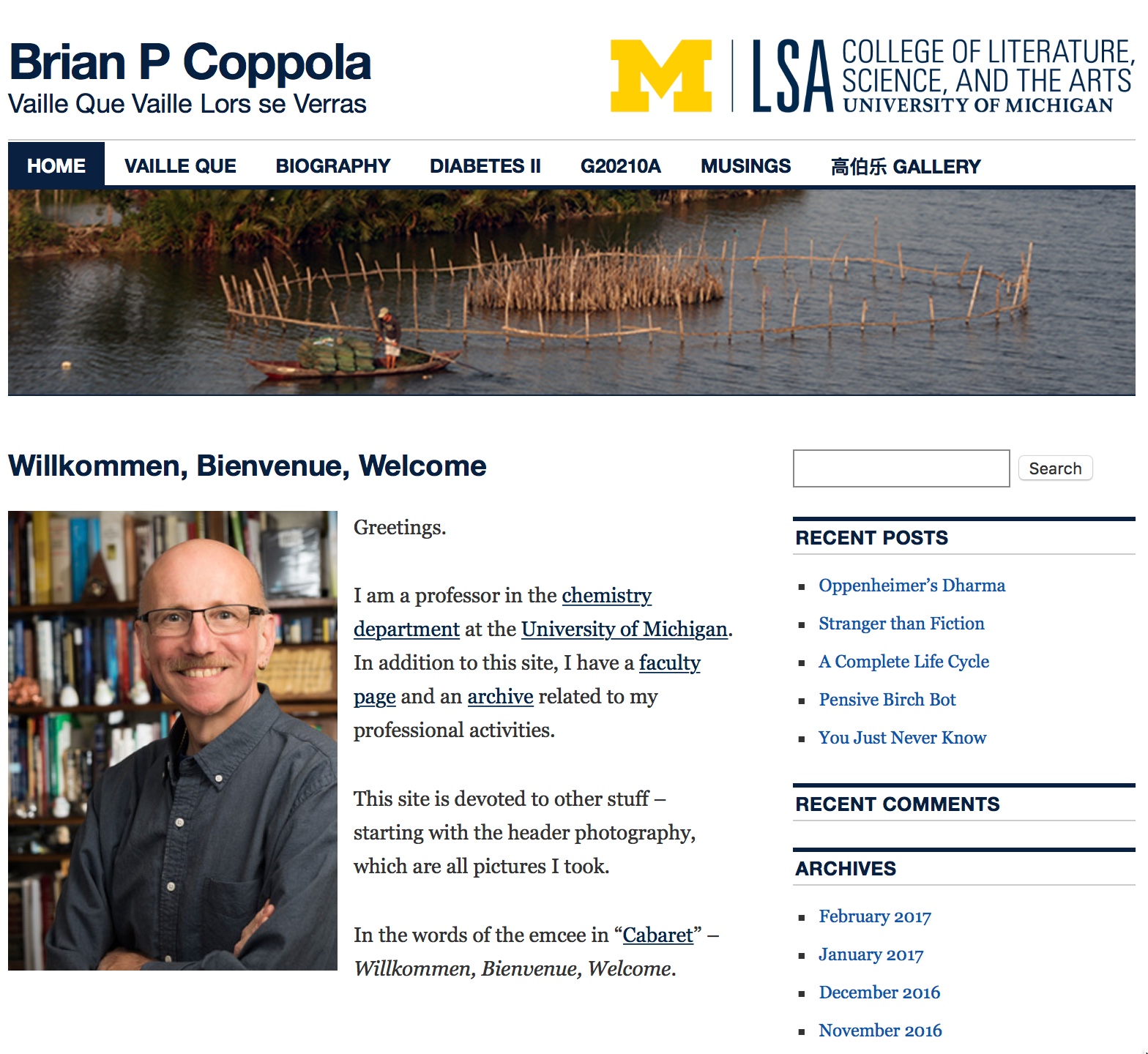
In case you were wondering: yes, those are all pictures of me on the homepage, one from each of the eras, above. The little guy with rational hair is from 1959; the disco hair over the turtleneck is from 1978; the giant frizz-head is from 1980; and the magical invisible hair is from 2008.


1984

My 3 earrings all commemorate professional milestones. The first, in 1982 (besides being really unusual for a chemist to do - at least back then) marks my first position as a faculty member; the second, from 1997, marks my tenure; and the third, from 2002, marks my promotion to Full Professor. And that is pretty much the story.


1997

On average, I think people take themselves too seriously and behave as though this life is a rehearsal (for what, I don't know). So my basic philosophies of life are as simple as fortune cookie fortunes:
"no one gets out alive"
"you can't take it with you"
"one goes as one goes, and
then one shall see" and
"I am having the time of my life"


2003

If those seem like the musings of a radical secular humanist, you would be right. Things don't happen for reasons, they just happen and we make up stories. Supernatural beings are neither guiding the universe nor paying special attention to this planet. Humans reproduce, you are born, stuff happens, then you die. Just a few minutes without oxygen and your brain checks out, and anything you knew, experienced or otherwise gave you identity is simply gone (unless something has been previously preserved in photographs, memories, writing, video...).


1994

Morality is such an extraordinary invention of our brains that, on average, our brains have an impossible time giving ourselves credit for it... which is, itself, I have to conclude, a conserved survival trait. Apparently, if human beings did not evolve a sense of supernatural causation and explanation, and left the question of morality to free choice, they could not handle the responsibility and it would provide less of a survival advantage (probably of social culture). That is, it would be harder to avoid social chaos, there would be no rule of law, and we'd spend lots of time figuring out how to kill one another. Oh, wait... When two cultures each think they have the moral high ground, they DO spend lots of time trying to kill one another.


1990

Being able to conceptualize something without needing to observe it, particularly to be able to anticipate things through the imagination and guide your actions to an advantage or self-satisfaction, is called by some "anticipatory scenario building." It allows species to navigate survival options.

If you can anticipate danger, imagine what will happen if you follow certain paths, and avoid death, this is a keen survival trait to pass on. Someone who does not recognize that there is a saber-tooth tiger around the corner (or bait in a trap) is not carrying a trait that is going to be conserved quite so well.

And if you develop the ability to take an experience you have had (saber-tooth ahead) and communicate that effectively to your tribe (and have them understand you) then your whole social unit can actually learn from your experience without having even encountered any part of it.


1974

And the better you are as a teacher, the better off your social unit is going to be.

Having an experience and being able to communicate it effectively is not only at the core of "teaching" (the way we think about it in schools) but also in all forms of performance. A performer takes an experience with life and tries to communicate its lesson - according to whatever skills the performer has, including visual arts, writing, theater, music, dance, television, and (yes, even) purple web sites.

"Art" (performance) is connected to a conserved survival trait (anticipatory scenario building), and begins to explain why we embrace it (art/performance/teaching) in its every manifestation.

Panoptics

Conceived in 1791 by Jeremy Bentham, the panopticon concept, now in the hands of cyber-libertarians, represents the literal and figurative all-seeing aspects of government & corporate entities who train their cameras on us, monitor our buying habits, and for whom we control our actions because we know we are being watched.

The internet is a panopticon, because we all watching each other, too, and controlling our actions, accordingly.

Let me suggest that Geoffrey Miller's proteanism (1994) provides an antidote to the panopticaon's control. A predator can most easily capture its prey when, upon observation and pursuit, the prey follow predictable behaviors (and become a tasty snack). From the run of a jackrabbit to the flight of a moth when it detects a bat, the key survival trait is a protean escape behavior - movements that are so random as to be unpredictable. So is mutation of DNA: without random variation in the background, we would become prey to the various organisms that would do us in.

The weapon of choice for your own predators is to create expectations about you. Bentham says that in the panopticon, you will control and conform your behavior to expected norms because you just never know when you are being watched, so you will assume that you always are.

Expectations result from someone else's predictive model about you. If you do something that is called 'unexpected' or 'surprising' then all you have done is violated the constraints that others have imagined to be true about you. Being 'unexpected' really means that someone else's predictive model for you was flawed.

The internet is a panopticon, but you have control over what is seen and over the decisions you make. And if you don't buy into the expectations of others, and follow at least a mildly protean path (be unpredictable), then you can also experience the liberation that comes with it (I'm not talking about posting your nasty bits at porn sites, by the way; that's a different topic).

You can lead with inference, and use ambiguity to coax your predators down the garden path - and you can learn a lot about them that way.

Or, at the very least, being a little unpredictable drives people nuts.

Travel

I enjoy greatly the experience of travelling around the country, and around the world. By far, my favorite cities to travel to and live in for a while are Beijing, London, and Washington, DC.

My Travel Page
An essay about China
China Research Exchange

Art

Wow. This one is really complicated because it is difficult to pin down just one type or style or medium that I collect.

Comic book and strip art
Bronzes
Asian antiquities
Modernist sculpture & jewelry
Pop art
Urban art
Contemporary Chinese art

That said, I'll leave you with this:

"Oppenheimer's Dharma" 2005


Musings


Well, that was fast.

August 30, 2009 - If you want to experience custom-made liquid nitrogen ice cream, it turns out you can, right now, in Chicago, at iCream.


Bragging Rights.

August 20, 2009 - One day, soon, you might be walking in your local Mall (Do people actually still go to Malls?) and see a super-space age ice cream stand bellowing clouds of misty smoke, and selling cyro-cream or some other commercial name for the product. It will be ice cream with a gelato-type of consistency, it will be delicious, and it will be prepared by cooling the ice cream mix down with liquid nitrogen. A patent for such a machine was awarded in late 2008.

When a patent is filed, the lawyers need to do a literature search to make sure your invention is original, and to provide the background. So there, in the reference list for this patent, you can see a paper written by me.

In 1994, after reading in Scientific American about two physicist-chefs experimenting with super-cooling ice cream mix with liquid nitrogen and getting creamy consistency with micro-crystals, among other culinary oddities, we figured this would make a more fun liquid nitrogen demo for kids than the usual frozen bananas and tennis balls. We were also pretty sure other people read Scientific American and pictures like this would not go unnoticed. The race was on!

So we tried this method out during a summer program: testing out some recipes, using pre-made mixes, and having kids stirring up their own ice cream in Styrofoam cups as we added liquid nitrogen - all to their gleeful delight. We lickety-quick wrote it up and sent it off to the Journal of Chemical Education; and while we have no idea how many people might have been thinking about it, we managed to end up with what will always be the original journal reference to "liquid nitrogen ice cream."

I'd (pretty much) say all of the people who do chemistry demos read this journal, and it (pretty much) spread around the world like a virus. Within a few years, making "Liquid Nitrogen Ice Cream" became a staple of many outreach and demonstration activities. And after a generation, the chances of people knowing about this story are (pretty much) lost to time.

Over the years, I've asked people who were doing the demo: do you know the original reference to this? No one ever does. And when I tell them, they tend to think it's impossible - this must have been around longer than that. Well, it wasn't, but I was not about to do a literature review on "liquid nitrogen ice cream" to prove my case. Now I can point to the patent, because those lawyers did the work for me.

And what do I get from all this? The only thing that matters, in the end: bragging rights.

So there. Neener-neener.


Thirty-Five Years Ago.

August 15, 2009 - Today my high school class celebrates its 35th reunion. I'm in London as I write this, so I certainly hope everyone had a nice celebration.

I'm not particularly inclined to attend events like this, though.

The Man from Earth.

August 10, 2009 - I recommend highly, if not higher than that, a film titled "The Man from Earth."

This is no regular "Sci-fi" movie. There are no space ships, aliens, ray guns, slime, robots, spandex, cute kids, explosions, or creatures that pop out from someone's belly. It's about an idea. A simple "What If?" scenario that then gets played out, and draws intelligently from a study of human reactions and behaviors.

"The Man from Earth" is a low budget piece made up of one long conversation that takes place in a cabin (an actual cabin, not a set), as an academic - surrounded by some colleagues from various disciplines, and who are surprised he's giving up his tenure and moving on - learn from him that he is a 14,000 year old man, who needs to "move on" as people begin to notice he does not age.

There's more, but that would be telling.

And it would make an incredible stage play.

Pure Joy.

July 31, 2009 - I direct a program where students from the US go to Beijing for 10 weeks of summer undergraduate research, and there is an equivalent number of students from China who come to the University of Michigan for a comparable amount of time. Providing this opportunity for global and international connection is definitely a highlight of what I do.


Twenty Years Ago.

Come gather 'round people
Wherever you roam
And admit that the waters

Around you have grown

June 6, 2009 - I was fortunate enough to be able to visit Tiananmen Square on June 4, 2009, on the twentieth anniversary of the (call it what you will) events of June 4, 1989.

Security was high (mainly checking for journalists – if you were merely a tourist, there was not really a problem), and there were a ton of badge-wearing volunteers carrying umbrellas (which were meant to be opened in passive resistance to block journalists from their camera crews).

There were crews of folks in color coordinated t-shirts who were in different zones of the Square.

We were there for about an hour or so, and while the crowds were a little thinner than usual, the place was still teeming with tourists from both China and from elsewhere. As typically happens, a family wanted to pose with us.

There were no banners, no attempts at any monkey business that we could see. Tourists and families from all over, and while no one was talking about it, there was a shared experience among the adults about the day, and about how much of a difference 20 years can make.

As the present now

Will later be past

The order is
rapidly fadin'.

And the first one now

Will later be last

For the times they are a-changin'.


A Great Wall.

June 1, 2009 - You know, this is just a picture of a painted wall in China, but I found it to be a totally appealling aesthetic subject.


The Hallucinatory Mind.

May 18, 2009 - Recently, cognitive scientists and magicians have been getting together to try and understand just why some illusionists are so successful, and how that all works. The answer is appears to be absolutely fascinating. We all spend a great deal of time hallucinating.

Think of the data taken in by your eye in terms of a digital image. There is a highly pixelated area of rich data in a small area of focus. As you move away from the focal area to the periphery of your vision, the amount of actual information registered by your eye is limited. Shocking. Because when you look at the world, is all seems pretty evenly pixelated. And here's the killer: your brain is filling in lots of information at the periphery of your focal area based on its past experiences with the world. You are hallucinating.

So when a magician pulls your attention with the right hand, it drops the left hand into your peripheral vision. If the magician then starts that hand along one physical path, your brain will literally fill in the rest based on past experience with motion, and you will see (that is "see") the end result of that gesture, not because it happened, but because you brain fills it in. So by changing the motion of the left hand in mid-stream, it can become effectively invisible because your brain will see its invented left hand doing what its trajectory suggests.

Not convinced? Want some proof? Here you go (forget the goofy story about the curve ball and experience this in the context that I just described).

http://illusioncontest.neuralcorrelate.com/2009/the-break-of-the-curveball


Crossing the Road.

May 8, 2009 - In our youth, we learn to cross the road with safety. We look both ways; we don't walk out between parked cars; we cross at the crosswalks; we are cautious of following rogue chickens who step off the curb; in places like London, they even tell us which way we should look; and in Singapore, they are pretty insistent that we only cross where we are supposed to cross.

But in Istanbul, a few years ago, I learned that there are other ways to cross the road. The Turkish people, you see, do not say "to cross the road." They say "to throw oneself into the traffic." I like that quite a bit in its broader metaphorical sense. Because if it is true, as Tom Cochrane says, that life is a highway, then throwing yourself into the traffic is definitely the way to go about it.